|
A TINY strip of land, sandwiched between the sea and the desert at the eastern end of the Mediterranean, is probably the most disputed piece of territory on earth. For thousands of years it has been fought over; in the last fifty years or so, it has been the focus of international attention as rival peoples have claimed their rights to the area. Not long ago there were promising moves towards reconciliation, and bitter enemies signed treaties of peace and security - yet the tension has continued to surface.
The parties which are directly at odds with each other in this dispute are the Israelis and the Palestinians. This booklet is being printed at a time of renewed conflict: Palestinian suicide bombings have provoked heavy Israeli reprisals, and serious-minded people are concerned about the worsening situation. What is really behind the so-called 'Palestinian Question'? And how can the Bible have an answer?
We shall first attempt to define the Palestinian Question and then look at what the Bible has to say which bears on the conflict. We hope to show that the answer depends not on human claims but on promises and prophecies given by God Himself.
"Palestine" and "Israel"
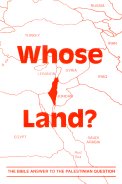
On the cover of this booklet is a map of the Middle East with a wedge-shaped area coloured in red: this area is the one under dispute. From the establishment of the modern state of Israel in 1948, up to 1967, Israel represented about three-quarters of the area; the remaining one-quarter being made up of the West Bank-occupied by the Kingdom of Jordan - and the Gaza Strip, under Egyptian jurisdiction (see map on next page). In the Six-Day War of 1967, Israel occupied the Gaza Strip and the West Bank, including Old Jerusalem1. Ever since, the Palestinians, many of whom lived in these areas, have been pressing for Israel to relinquish control and agree to the setting up of a separate Palestinian state.
International negotiations - in recent years referred to as "the peace process" - led Israel in 1994/5 to grant self-rule over certain areas which now make up the Palestinian Authority: Jericho and other West Bank towns and villages, and most of the Gaza Strip. The newly founded PA is not autonomous, but in 'land for peace' deals Israel agreed to a gradual handover of control to the Palestinians. The Palestinians, backed by the wider Arab world, are however not content with this gradual process and have become ever more insistent on their rights to the land - in fact, it is no secret that they want the whole area, and Jerusalem as their capital. Internationally agreed proposals for Arab-Palestinian independence have, however, more than once been refused: it happened in 1947 prior to the setting up of the state of Israel, and it happened as recently as 1999 when Yasser Arafat, PA Chairman, rejected an offer made at Camp David (in the USA) that would have paved the way for a fully fledged Palestinian State. The situation, as we write, is at an impasse.
If we are to understand the current situation, we need to know more about the identity of the parties in this dispute, and the historical background.
Conflicting Claims
Israel, although it has citizens from other ethnic and religious groups, is a largely Jewish state: of a total population of 6.5 million, just over 5 million are Jews. Jews all over the world claim that their rights to the area - in fact an area extending well beyond the present boundaries - date back at least 4,000 years to the time when their forebears, the descendants of Abraham, Isaac and Jacob, first lived there. We shall have more to say about this, on the basis of what is recorded in the Bible.
The Palestinians also claim a longstanding connection with the area. They point out that the Arabs are also descended from Abraham but through Ishmael, Esau and others: they are, in origin, cousins to the Jews. Those who live today in the disputed areas of the West Bank and Gaza Strip claim an equal right to the land on the basis of descent from Abraham; but they also base their claim on centuries of occupation of the land, and argue that the Jews for whom the Israeli state was established are more recent immigrants - with less claim to live there. These are claims which need closer investigation.
Jews and Arabs in the Land
But let us first review briefly the events which have led up to the present situation. We need to go back a lot further than 1967 or 1948: later in this booklet we shall go back several thousand years to the times of the forefathers of the Jews and Arabs, but for the moment let us look at just the past 2,000 years.
There is no dispute about the fact that at the beginning of the 1st century AD, in the time of Jesus Christ, Palestine was populated by Jews. The Land was under Roman rule. Eventually, however, the Jews rebelled to such an extent that the Romans besieged Jerusalem; in AD 70 the temple was destroyed; thousands of Jews perished and most of the rest were banished - migrating to all points of the compass.
Yet, in spite of the Roman expulsions, some Jews remained in the Land, particularly in Galilee, and continued their Jewish way of life; and as the centuries passed, so more and more migrated back. In 'the four holy cities of Judaism' - Jerusalem, Hebron, Tiberias and Safed - there has been continuous Jewish settlement since Biblical times. As successive conquerors came and went - Byzantines, Arabs, Crusaders, Mamelukes, Ottomans, British - Jews, sometimes tolerated, often persecuted, survived. Throughout most of this period, from the 1st to the 19th centuries AD, the Land was largely desolate. Palestine was, in fact, not a country as such; and there was no such thing as a Palestinian people. Arabs and Jews simply lived alongside each other, generally at peace.
In view of the current situation, which involves so much antagonism between Moslems and Jews, we are bound to ask what effect the rise of Islam (the Moslem religion) had in the 7th century AD. Initially, Jews continued to have reasonably good relations with Arabs - many Jews in fact lived and prospered in Moslem lands, including Arabia. At some stage, the prophet Muhammad had said, "Two religions may not dwell together on the Arabian Peninsula"; and there are passages in the Koran which incite Moslems to rise up against Jews. Nevertheless, for nearly 1300 years, Jews and Arabs in the Middle East tolerated one another. During the same period, it has to be said that Jews suffered more at the hands of so-called "Christians", particularly during the Crusades.
Zionism and the Jewish 'Return'
In the 19th century, there was a fresh wave of Jewish immigration to the Holy Land, and the end of that century saw the significant rise of Zionism. In the early 20th century, Britain took an interest in the idea of a homeland for Jews and the Balfour Declaration was issued:
"His Majesty's government view with favour the establishment in Palestine of a National Home for the Jewish people, and will use their best endeavours to facilitate the achievement of this object, it being clearly understood that nothing shall be done which may prejudice the civil and religious rights of existing non-Jewish communities in Palestine..."
After the First World War, the League of Nations appointed Britain as the Mandatory Power for Palestine - and by the term "Palestine" they meant, not just the area west of the Jordan but a much more extensive region, from the Mediterranean to Arabia and present-day Iraq, and from Egypt to Lebanon and Syria. In 1921, however, Britain - in a gesture designed to win Arab favour - gave the territory east of the Jordan (initially called Transjordan) to Sheikh Abdullah. Subsequently this was to become the Kingdom of Jordan. Jordan also gained the West Bank, so that the territory which, in 1948, finally became the State of Israel was a small fraction of the originally intended Jewish homeland.
These developments led to a highly significant change in the use of the terms "Palestine" and "Palestinians". Up to then, "Palestinians", in the eyes of most people, would have been Jews, or perhaps Jews and Arabs, living in the Land. From now on, and especially when a Jewish state was established called Israel, "Palestine" came to be used exclusively in connection with non-Jews. Moreover, at least up to 1948 when the state of Israel was proclaimed, Jordanian rulers (and others) were content to see the territory east of the Jordan as the obvious homeland for Arab Palestinians. That solution, however, has since been rejected - with the consequences we see today.
Continuing with the history of the Land after World War I, the migration of Jews to the mandated area gathered pace; so did the influx of non-Jewish peoples, including Arabs, from other countries. To begin with, the various groups worked together, cooperating in the development of agriculture and industry and sharing in the prosperity. Sadly, and not unexpectedly, tension did eventually surface; and by the time proposals were being made for the formal establishment of a Jewish state, serious conflict began. When the British left in 1948, there was all-out war between Jews and Arabs, and the half century which has followed has seen successive outbreaks of hostility. The first Arab-Israeli wars were between the surrounding Arab states and Israel; lately, the conflict has arisen largely within Israel's borders.
The Palestinian Claim to the Land
Christadelphians do not take sides in the Arab-Israeli dispute, nor do we wish in this booklet to promote political views. We are, however, bound to take notice of evidence that not all the arguments of the Palestinians are well founded. Independent research shows that not all of those at present in the towns and villages of the West Bank or in the refugee camps of Gaza, Jenin or Lebanon, can legitimately claim a centuries-old association with the soil of Palestine. There is clear documentation that many are from families who came to Palestine during the period of the British Mandate, between World Wars I and II, or even more recently; they were mostly economic migrants - and not just Arabs, but speaking (it is said) up to 50 different languages. There were indeed a few hundred thousand people dispossessed from their properties in what is now Israel - but certainly not the whole Palestinian population, as is often implied.
Israelis would in any case point out that a great number of Jews were dispossessed from Arab lands, in which their forebears had lived for centuries. Sadly, tragically, war and calamity have displaced countless groups of people all over the world: the joy of the Christian Gospel is that all who will follow Christ - whether from the Middle East, or the Balkans, or Afghanistan, or Africa, or wherever - are offered a kingdom of permanence and peace.
More important, however, than arguments over politics or statistics are the facts that we can find in God's Word, the Bible. By turning back the pages of history, recorded in the Scriptures, we can find encouragement for both Jews and Arabs - and the Bible is the only place where these things are recorded. It should be mentioned that although Arabs have their own Moslem holy book, the Koran, they acknowledge most of what is recorded in the early books of the Jewish Scriptures, which are very much older.
Bible Background
Abraham has been mentioned in connection with both Israel and the Palestinians: both Arabs and Jews share Abraham as their forefather. They are Semitic peoples, that is to say, descended from Shem, the eldest son of Noah. After the great Flood, Noah's descendants were dispersed into all parts of the earth.
It was from moon-worshipping Chaldea that the LORD God called Abraham, his wife Sarah and his orphaned nephew Lot to live in Canaan, a territory south of the Euphrates river and stretching down to Egypt. It was a territory then inhabited by Canaanites, Philistines and other Godless tribes. Faithful Abraham was promised that the curse of Babel would one day be reversed and,
"I will make you a great nation; I will bless you and make your name great... and in you all the families of the earth shall be blessed." (Genesis 12:2,3)
A remarkable promise indeed! But when Abraham reached Shechem (present-day Nablus in the West Bank) - the first time he had set foot in the disputed territory of Canaan - God added: "to your seed I will give this land" (Genesis 12:7). Later, from the hills north of Jerusalem, God commanded him:
"Lift your eyes now and look from the place where you are - northward, southward, eastward, and westward; for all the land which you see, I give to you and your seed for ever." (Genesis 13:14,15)
The extent of this promised possession was marked out in Genesis 15:18-21: "From the river of Egypt (in the south) to the great river, the River Euphrates" (in the north-east).
But there was a problem. The land was promised to his "seed", yet Abraham and Sarah were old and had no children. Aged 86, Abraham then took Hagar, Sarah's Egyptian maid, as his wife. Hagar received an angelic message that her son should be "Ishmael", an Egyptian name meaning 'God hears'. A promise of a great family was made concerning Ishmael:
"I will so increase your descendants that they will be too numerous to count... He will be a wild donkey of a man; his hand will be against everyone and everyone's hand against him." (Genesis 16:10-12, NIV)
The Arab Heritage
That was a very revealing forecast! Ishmael was to be the father of bedouin Arabs, desert dwellers in Arabia. The situation was later confirmed to Abraham when, still having no son by Sarah, he pleaded with God that Ishmael might be his heir:
"Then God said: No, Sarah your wife shall bear you a son, and you shall call his name Isaac; I will establish my covenant with him... As for Ishmael, I have heard you. Behold, I have blessed him, and will make him fruitful, and will multiply him exceedingly. He shall beget twelve princes, and I will make him a great nation." (Genesis 17:19,20)
History confirms the existence of the twelve branches of Ishmael's family. Isaac in due time received confirmation of the promises through him; and, in turn, they were repeated to his son Jacob:
"The land on which you lie I will give to you and your descendants... I am with you and will keep you wherever you go, and will bring you back to this land."(Genesis 28:13-15)
On the contrary, the future for Esau, Jacob's twin, was: "Behold, away from the fatness of the earth shall your dwelling be ... by your sword shall you live." (Genesis 27:39,40, RSV)
God gave Esau a possession in the dry, red deserts of Edom, down by the Dead Sea (Deuteronomy 2:5). Abraham and Isaac had settled in the land of promise and he had sent his other sons "eastward... to the country of the east" (Genesis 25:6). Midian's children became desert caravanners, and Sheba and Dedan occupied southern Arabia. From Abraham's nephew Lot came the Ammonites and Moabites who inhabited the land east of the river Jordan.
A Divided Family
Thus we get an overall picture of a divided family: on the one hand, Isaac, Jacob and the twelve tribes of Israel (the name which God later gave to Jacob) eventually being established in the promised territory and, on the other, the Arab sons and families moving eastward and southward away from the "promised land". The Bible is very clear that the "children of Israel", the Jews, were the divinely appointed inhabitants of the Land. After a period in Egypt, the migration referred to as the Exodus, under the leadership of Moses and Joshua, brought them back as an organised nation, with God's law given to them at Sinai, to inhabit the Land.
Israel's inheritance of the Land was always (and still is) subject to His people remaining obedient to Him. The Bible's Old Testament presents the history of loyalty alternating with faithlessness. There were further periods of harassment by their neighbours, and exile. Yet, even then, and despite their faltering faith, God remembered His promises and brought them back.
It was 500 years after the return from exile in Babylon that Jesus came into the world - the long promised Jewish Messiah. The Jews of the time flocked to listen to him and benefit from his miraculous powers; yet few in the end accepted him, and once again their fate was to suffer persecution and dispersion. The Romans besieged their holy city, Jerusalem, and Jews were driven into almost every country of the world. They were destined to wander - though not for ever.
Has God forsaken His People?
Had God cast away the Jews? Was their rejection of the Messiah the end of God's plan with His once-chosen people? Many maintain that this is so, and that the God of Israel has no further purpose with the Jews - that Christians and not Jews are now the focus for the outworking of God's promises for the future. It is true that God's purpose is with those who believe and obey Him, of whatever race; nevertheless, God has not forsaken His chosen people, the Jews.
The centuries of bitter persecution have come and gone; the pogroms of Europe brought indescribable terror upon Jewish communities in their day; the unspeakable violence of the Second World War is something mankind may never erase from its memory. But God has not forgotten. Did He not say through His ancient prophets, for example, Ezekiel -
"I will... deliver you into the hands of strangers, and execute judgements on you... (yet) although I have cast them far off among the Gentiles, and although I have scattered them among the countries... I will gather you from the peoples, assemble you from the countries where you have been scattered, and I will give you the land of Israel." (Ezekiel 11:9-17)
It is abundantly clear that the Jew, despite his terrible tribulations, has survived. Why? So that Jews could continue to be God's witnesses among the nations. Jews survive not through any merits of their own, but as a testimony that God keeps His promises and will fulfil what He covenanted to Abraham, Isaac and Jacob. Isaiah records why Israel survived:
"But now, thus says the LORD, who created you, O Jacob, and he who formed you, O Israel: Fear not, for I have redeemed you; I have called you by your name; you are mine... You are my witnesses, says the LORD, that I am God." (Isaiah 43:1,12)
Witnesses to God's Will
The repatriation of Israel is a very notable sign to the world that God is in control: He is in control of all world events, but in particular He has controlled the destiny of the peoples of the Middle East - Jews and Arabs - in accordance with His ancient promises. What is happening in the Middle East is part of the outworking of God's determined purpose, and the present terror and tragedy will culminate, finally, in events which will usher in the kingdom of God and of Christ His Son.
For it is through Jesus Christ, the Son of God, the particular "seed" of Abraham, the promised Messiah, and through him alone, that there is hope. This is not the place to go into detail about the work of Jesus Christ, and the meaning of his death and resurrection, or the expectation of his coming again soon, to rule as king over God's universal kingdom - other pamphlets are available which deal with these themes.
For the purposes of this present booklet, we must content ourselves with simply stating what every true follower of Jesus believes: that God has foretold, "in the latter days", "a time of trouble such as never was" (Daniel 12:1). Before Christ returns to the earth, there will be terrible trouble, particularly in the Middle East. Many of the Old Testament prophets, and New Testament prophetic passages too, foretell the catastrophic events that will precede Christ's coming, and that will lead, finally, to the setting up of a kingdom of justice and peace. Ezekiel, for example, writes of a coalition of nations that will threaten Israel "in the last days". "Gog", their leader, will say:
"I will go to a peaceful people, who dwell safely... against a people gathered from the nations... who dwell in the midst of the land (at the centre of the earth, RSV)." (Ezekiel 38:11,12)
Zechariah speaks of a "day of the LORD", a time of war, when the LORD God will finally intervene and send His Son:
"The day of the LORD is coming... For I will gather all nations to battle against Jerusalem; the city shall be taken... Then the LORD will go forth and fight against those nations... And in that day his feet (the Lord Jesus, see Acts 1:11) will stand on the Mount of Olives... And the LORD shall be King over all the earth." (Zechariah 14: 1-9)
Events to Come
After 2,000 or more years of man's misrule, Jesus Christ will re-establish God's kingdom, first of all on the territory promised to Abraham and his descendants, and ultimately throughout the world. A rebuilt Jerusalem will be its capital, the centre of worship for the whole world, "a house of prayer for all nations" (Isaiah 56:7).
This is the true Christian hope: this is what the Bible teaches. Most Jews today have no interest in these things; many no longer believe in God, and very few acknowledge Christ; yet the Bible (again both Old and New Testaments) foretells a conversion of at least some of the Jews, who will look on him whom they pierced and mourn (Zechariah 12:10). "The Deliverer will come out of Zion, and he will turn away ungodliness from Jacob" (Isaiah 59:20; Romans 11:26). God is looking for those - whether Jew or Gentile -who believe in Jesus Christ His Son; and in the end, "there is neither Jew nor Greek, there is neither slave nor free, there is neither male nor female; for you are all one in Christ Jesus. And if you are Christ's, then you are Abraham's seed, and heirs according to the promise" (Galatians 3:28,29).
What about Ishmael and the Arabs?
Will God ignore Ishmael? We have referred to the promises made to Ishmael's descendants: "I have blessed him, and will make him fruitful... I will make of him a great nation" (Genesis 17:20). Much of this has been fulfilled already: the Arabs have been prosperous and become a great multitude, contributing much to world culture. What hope is in store for them in the future?
If, like any other people, Arabs acknowledge the God of Israel and the Lord Jesus Christ they will live alongside the descendants of Isaac and Jacob, helping to rebuild the economy of the area, benefiting from the blossoming of their deserts and sharing in the joys and blessings of the kingdom. Isaiah, for example, pictures Arabs and others bringing service and worship into Jerusalem:
"The multitude of camels shall cover your land, the dromedaries of Midian and Ephah; all those from Sheba shall come; they shall bring gold and incense, and they shall proclaim the praises of the LORD... And they shall call you, The City of the LORD, Zion of the Holy One of Israel." (Isaiah 60:6-14)
"In that day there will be a highway from Egypt to Assyria... Israel will be one of three with Egypt and Assyria, even a blessing in the midst of the land, whom the LORD of hosts shall bless, saying, Blessed is Egypt my people, and Assyria the work of my hands, and Israel my inheritance." (Isaiah 19:23-25)
Harmony and peace will, at last, come to the family of Abraham. The Middle East will be gloriously transformed.
But the promises extend more widely than to just the nations of the Middle East. God's purpose is something personal and vital to every one of us, of whatever nationality, if we wish to be part of the divine plan for the future. Jesus is the Saviour of men and women from every race, language and creed on earth - if they truly believe in him. "God so loved the world that He gave His only begotten Son, that whoever believes in him should not perish but have everlasting life" (John 3:16).
No-one will be excluded, who changes his life to be a follower of Jesus Christ. God's plan is a world-wide plan of salvation: remember the promise that through Abraham "all families of the earth" will be blessed. That includes Gentiles and Jews. The apostle Paul was a converted and baptized Jew and he wrote to baptized Gentiles:
"As many of you as were baptized into Christ have put on Christ ... And if you are Christ's, then you are Abraham's seed, and heirs according to the promise." (Galatians 3:27-29)
Our Appeal to You
Whose Land? To those involved in the current dispute over Palestine, this is a vexed question about which both sides feel very intensely. There is anger and frustration among both Israelis and Palestinians today - and little sign of a solution that both will accept.
By looking at what the Bible says, and seeing the enmity of Arabs and Jews in the longer perspective of God's purpose, we have tried to show that there is an answer to the Palestinian Question, an answer which will be to the benefit of both Jews and Arabs - if they believe in Jesus Christ. In the context of God's eternal purpose, the ownership of the 'Land' today is actually of less importance. What really matters is who will inherit, not just this strip of land, but God's Kingdom to be set up on earth. This is a Kingdom for those who "desire a better country" (Hebrews 11: 14-16). For them, God has prepared His kingdom - and it may not be very long before this is established. If you wish to be a part of that Kingdom, think about these things now, and take the necessary steps to associate yourself with the Lord Jesus Christ.
STANLEY OWEN
Bible quotations are from the New King James Version except where otherwise indicated
Second Edition - 2002
1. In 1967, Israel also annexed a region to the north-east of the Sea of Galilee (part of Syria) called the Golan Heights. The Sinai peninsula was also taken, but later handed back to Egypt.
2. "Palestine" has been a name associated with the coastal part of the red-coloured area on the cover map since AD 135, and is derived from 'Philistine', the name of a tribe who lived in this area in ancient times. In adopting this name, the Palestinians do not, however, suggest that they are descended from the Philistines, who were a non-Arab, non-Abrahamic people.
|
 LIBRARY