
Home
Preface
Abbreviations Used
Introduction
General Subjects
Exposition
Matthew
Mark
Luke
John
John 14-16
Acts
Romans
1 Corinthians
2 Corinthians
Galatians
Ephesians
Philippians
Colossians
1 & 2 Thess.
1 & 2 Timothy
Titus
Hebrews
James
1 & 2 Peter
1 John
Jude
Revelation
Gifts of the Spirit
Inter-Ecclesial Offices
Word Studies
Bibliography
Index
Epilogue Acknowledgements
Like most of the ecclesias established in the first century, Corinth was established by the Apostle divinely commissioned to preach to the Gentiles1 by a demonstration of the power of God. Thus the operation of the Spirit gifts was something that all at Corinth should have been familiar with from the foundation of the ecclesia. They should have understood clearly the source and purpose of the gifts as well as the added responsibility placed upon those who had them. To the Corinthians Paul was able to say that "ye come behind in no (spirit) gift", but this did not prevent grave problems among them. Doubts were cast by some on the doctrine of the resurrection, there was drunkenness and gluttony at the Breaking of Bread service. This had invoked the judgement of God so that some had even died. There were other problems:
- worship of leaders rather than of Christ (3:1-9). Those who had the office of governments (12:28) should have corrected the situation.
- going to law before the unbeliever (6:1).
- misuse of tongues (chap. 14).
- sisters were prophesying in the ecclesia and had their heads uncovered (ch. 11).
- Judaizers had made inroads.
All of these problems had arisen within 25 years of Pentecost and within five2 years of the establishment of the Corinthian ecclesia by Paul. Obviously the gifts of the Spirit had been misused or not used at all, otherwise the ecclesia would have been edified and been a "mature man" (cf. Eph. 4:12, 13).
Try to picture the situation that Paul had to deal with. He had taught them the truth, imparted to them the gifts of the Spirit and now they claimed that
- his apostleship was self assumed (2 Cor. 3:1)
- he exhibited insincerity of purpose (2 Cor. 1:12-24)
- he lacked apostolic credentials (2 Cor. 3:1-3)
- he embezzled ecclesial finances (2 Cor. 7:2).
What a terrible state of affairs in an ecclesia that was "not lacking in any gift". This ecclesia shows beyond doubt that possession of even the best gifts did not guarantee a righteous ecclesia. However, things would have been worse had they not possessed the gifts as is evident from Paul's statement
"covet earnestly the best gifts" (1 Cor. 12:31)
To seek the gifts today is to miss one of the primary messages of Corinthians. The gifts were temporary, childish things which only mirrored a dark image of the completed scriptures. The more excellent way was and is agape (love).
1 He was "a chosen vessel" (Acts 9:15).
2 Gallio's proconsulship of Achaia (Acts 18:12-17) was AD 51-52 because of the inscription found at Delphi in 1905 (CBSC on the NEB P. 18, 19). The dispatch of 1 Corinthians is normally placed at about AD 54-55.
- 1 Cor. 1:4
- "for the grace of God which is given you by Jesus Christ;"
"Grace" (Grk. charis) is probably a reference to the spirit gifts (cf. Eph. 3:2; 4:7) which follow immediately. We sometimes use favour for a disposition of the mind and sometimes for gifts. The latter seems to be demanded by the context.
"of God" indicates the source (cf. Rev. 1:1).
"is" should be "was" (NASB).
"by" should be "in" (RSV, MARS, NASB, MOFF, ROTH)
Paul renders thanks to God for those gifts which God had bestowed upon them through Paul3 by virtue of their union with Christ. Paul is not saying that Christ gave the Corinthians these gifts directly as some would have us believe.
3 See 1 Cor. 9:2. Evangelists, who were not Apostles, could have converted them but only an Apostle could bestow the Spirit gifts that the Corinthians had. (cf. 12:4-11).
- 1 Cor. 1:5
- "that in everything ye are enriched by Him, in all utterance, and in" "by" S/B "in" as in v. 4.
"utterance" probably referred to the gift of:
- tongues
- interpretation
- prophecy
and possibly to the offices of:
- prophets
- teachers—but we cannot be sure of the exact category.
But of what value were these gifts if they contributed not to concord but discord and rivalry? V. 10 supplies the answer. Therefore Paul is thinking of the gifts themselves, rather than the use they had made of them.
- "all knowledge"
This refers to the gift of knowledge and possibly the gift of wisdom.
- 1 Cor. 1:7
- "So that ye come behind in no gift;"
RSV has "so that you are not lacking in any gift" (cf. 1 Cor. 14:18). Chapters 12-14 are evidence of this statement by Paul.
- "Awaiting eagerly the revelation of our Lord Jesus Christ"
This probably is to be understood in the same way as 1 Cor. 14:26; 2 Cor. 12:1; Gal; 1:12, 16. The Corinthians were so preoccupied with their abuse of the gifts that probably they were unconcerned about the return of Christ.
- 1 Cor. 2:4
- "And my speech4 and my preaching was not with enticing words of man's wisdom, but in demonstration of the Spirit and of power."
Paul did not rely on his own skill in argument or persuasion. He demonstrated he had the Spirit. Let those who claim to have the Spirit demonstrate it in miracles.
"demonstration of the Spirit and of power" may mean "demonstration by the power of the Spirit" (NBCR). Note v. 5 which has "power of God".
4 Greek logos. See Section F - WORD.
- 1 Cor. 2:9-16
- "...Eye hath not seen, nor ear heard, neither have entered into the heart of man, the things which God hath prepared for them that love him. But God hath revealed them unto us by His Spirit: for the Spirit searcheth all things, yea, the deep things of God. For what man knoweth the things of a man, save the spirit of man which is in him? even so the things of God knoweth no man, but the Spirit of God. Now we have received, not the spirit of the world, but the spirit which is of God; that we might know the things that are freely given to us of God. Which things also we speak, not in the words which man's wisdom teacheth, but which the Holy Spirit teacheth; comparing spiritual things with spiritual. But the natural man receiveth not the things of the Spirit of God: for they are foolishness unto him; neither can he know them, because they are spiritually discerned. But he that is spiritual judgeth all things yet he himself is judged of no man. For who hath known the mind of the Lord, that he may instruct him? But we have the mind of Christ."
Paul was writing this section (ch. 1:17 - 2:16) to combat the inroads of 'gnosis' - the intellectual wisdom of the Greeks - into the Corinthian ecclesia. "Christ crucified... (was) unto the Greeks foolishness" and so they began to amend the gospel by saying such things as there was "no resurrection" (ch. 15).
- Therefore Paul writes this section with several main arguments:
- the gospel is not wisdom of speech (1:17).
The Greek speaker was skilled in oratory and gave great eloquent dissertation. However, Greek orators were among those "that perish". - this wisdom of the wise will be destroyed (1:19).
Since the gospel is foolishness to the wise of this world, they will perish along with their wise speeches. - "What have the philosophers… to show for all their wisdom?" (Phillips) (1:20)
The answer is nothing that is lasting. The Corinthians should not be caught up with this worldly cleverness since God will destroy it. - "God through the folly of what we preach (will) save those who believe." (1:21) (RSV)
The Greeks may classify it as folly but it will give salvation. - "The foolishness of God is wiser than men." (1:25)
- "God has chosen the foolish" and "weak things of the world" to confound worldly wise. (1:27).
- Yet those in Christ have been shown a wisdom that is from God. (1:30).
- the gospel is not wisdom of speech (1:17).
- Having laid the groundwork of his argument, Paul then adds to it.
- He shows that his actions agree with his argument (v. 1- 4).
- "I came not with excellency of speech" (v.1) agrees with point IA.
- "I determined not to know anything among you except Jesus Christ and him crucified" (v. 2) agrees with I.B.
- The Greeks championed the Isthmian games and to admit weakness and fear was folly cf. I.E.
- He further contrasts Greek sophistry with the wisdom of God. (v.5-16).
- Paul had demonstrated that his statements were true "by spiritual power", the Greeks merely said enticing words. (v. 4).
- It is reasonable that the Corinthians' faith should "rest" (RSV) in what has been demonstrated by the Spirit and not what is recognized as the "wisdom of men" (v. 5).
- Paul "speaks" or reveals this wisdom to those who are "the mature" (RSV v. 6). Yet this wisdom is not the same as the Greeks' ("wisdom of this age") nor the same as the Jews' (wisdom "of the princes of this age") which comes to nought.
- The Greeks had many sororities that had secrets, which were not revealed until a person
had been initiated into them. They thrived on these mysteries. Paul shows that the gospel not only
has a secret wisdom but it is also hidden and it was a much older wisdom.
"But we impart a secret and hidden wisdom of God, which God decreed before the ages for our glorification" (v. 7 RSV).
- Indeed this wisdom is so hidden that "none of the rulers of this age" (v. 8 RSV) knew it. Had they known it, they would not have crucified the Messiah.
- In fact, this wisdom is so secret and hidden that it is beyond the hearing, beyond the seeing and beyond the imagination of any human philosopher! (v. 9 of NEB) This wisdom is only prepared for those who love God.
- God had revealed these things firstly to the Apostles by His Spirit, (the "us"
of v. 10 refers to the Apostles) and secondly by "the things also we (Apostles) speak". (v. 13).
The transmission of this divine revelation was achieved by that "which the Holy Spirit teacheth". It was the power of the Holy Spirit5 through the Apostles6 that conveyed the things of God to "them that love him".
- Paul gives an illustration of the meaning of "the Spirit searcheth all things, yea, the deep things of God." The Spirit was the Holy Spirit that had been given to Paul and it enabled him to use Isa. 64:4 correctly. The "deep things" (v. 10) were the Old Testament mysteries that had not previously been explained.
- The Spirit of God not only had revealed to Paul the Old Testament but also "the things of God" (v. 11). Paul7 had not received that which revealed "the things of a man" since that was only the mind of the world (which would pass away) but he had received the Holy Spirit which enabled him to "know the things freely given to us of God." (v. 12 NASB).
- Once Paul knew these things he spake them to others. Natural men would not receive the
spoken word, for they were "foolishness unto him, neither can he know them because they are
spiritually discerned". (v.14). This does not mean that those who discerned them must have the
Spirit as a possession; it only means they must "love" God and "believe" him. (Ch. 2:9; 1:21). That
is the mark of a spiritual man in contrast to a natural man (as contrasted throughout this passage).
The Spiritual man is one with the proper initial disposition of teachableness.
- He shows that his actions agree with his argument (v. 1- 4).
5 1 Cor. 2:4, 13.
6 In the Corinthians' case it was Paul, Silvanus and Timotheus (2 Cor. 1:19).
7 and Apostles.
- 1 Cor. 2:15
- "But he that is spiritual discerneth all things, yet he himself is discerned of no man."
Problem:
- Because there is no outward manifestation by those claiming present possession of the Holy Spirit, this verse is cited as proof, that it is there, only not discernable.8
- The AV has "is judged of no man."
The person who does not wish to demonstrate his claim to possession of the Spirit hides behind this statement.
Solution:
- The immediate context (v. 16 and ch. 3:1) indicates that the mind is the subject of discussion.
"who hath known the mind of the Lord."
In Rom. 8:6 Paul writes about the need to be "spiritually minded" and reminds us that to be "carnally minded is death."
- The AV margin ("he himself is discerned of no (natural) man") is the preferred reading as is evident upon consultation with other versions9.
- The plain teaching of scripture is that we are to "try the spirits" 1 John 4:1 because many false prophets10 are gone out into the world. Those enlightened by the word will judge the claims that are made.
- One of the Spirit gifts was "the discerning of Spirits". This would enable the possessor of this gift to determine when the manifestation was of God or false. It is, therefore, IDLE to use the above verse as in Problem 2.
8 cf. Notes on John 10:41 and Section B - "The Supposed difference between the Holy Spirit and Gifts of Holy Spirit", which answers this problem.
9 cf. AV v. 14 "are spiritually discerned" (Gk. "Anakrino" to investigate (B)).
"but his own true value no unspiritual man can see" (GSPD).
"while he is properly valued by none" (BERK).
"although he himself is understood by no one" (TCNT).
10 This is emphasized many times in the NT:
2 Pet. 2:1 "there shall be false teachers among you."
2 Thess. 2:2 Paul warns them against being misled "by Spirit nor by word".
1 Thess. 5:19-22 "Prove all things."
2 Tim. 3:8 Paul's words mean that errorists would imitate the Spirit gifts as the magicians did Moses' signs.
Rev. 2:2 "Thou hast tried them that say they are Apostles, and are not."
cf. also the false prophets and magicians of Old Test. times, Section E - "Prophets".
- 1 Cor. 3:16
- "Know ye not that ye are the temple of God and that the Spirit of God dwelleth in you?".
Problem:
- This verse is taken as evidence by those who claim they have the Spirit, "There can be no greater honour for us, yet it is something which we rarely care to call to mind. We can hardly expect to remain a tabernacle for the Spirit with such forgetfulness"11
Solution:
- The passage refers to the Corinthian ecclesia as a whole and not to each separate individual. Paul says:
- "You are ... God's building" 12 (v. 9).
- "I ... laid a foundation."12 (v.10).
- "Someone else is putting up the building" (temple) (v. 10 NEB).
- "But let each man be careful how he builds." (v. 11), because the day of judgement will reveal what sort of building materials the builder used.
He then says in effect:
If you do not build but destroy then you will
"be destroyed by God"because "the temple of God is holy" and you (the Corinthian ecclesia) are "that temple",
as must surely be evident to you since "the Spirit of God dwells" with you. (i.e. in the form of Spirit gifts13.)
- Paul uses similar language in 2 Cor. 6:16.
'For we are the temple of the living God; just as God said, "I WILL DWELL IN THEM AND WALK AMONG THEM: AND I WILL BE THEIR GOD, AND THEY SHALL BE MY PEOPLE."' 12
These words, which referred to the nation of Israel (and the way in which God dwelled with them through the Glory of the Mercy Seat); Paul now applies to the Ecclesia in Corinth.14 This concept, therefore, did not start at Pentecost; it belongs to previous ages.
- The words of this verse do not require that "each believer15 at Corinth had the Spirit." They only require that some possessed the gifts.
- This status did not cause righteousness as is clearly evident from v.3 "Ye are carnal".
11 ESSA, P.17 12 NASB 13 "You are not lacking in any gift" (1 Cor. 1:7). 14 see 1 Tim. 3:15. 15 It would appear that all did, however. This is very strong evidence that no one possesses the Spirit today. The gifts were so widespread in the first century that the wild claims of so few today can be rejected on that basis alone.
- 1 Cor. 4:20
- "For the kingdom of God is not in word, but in power."
The context determines the meaning. The "word" refers to the statements of those who had become arrogant (v. 19) and supported the actions of the man who practiced incest (5:1) by boasting (5:6) of their liberty as Christians. It does not refer to the written word (Bible) but to the talk (RSV) or speech (MARS) of an arrogant faction at Corinth. Those who attain the kingdom will do so not because of what they say but because of their deeds.
- 1 Cor. 4:21
- "shall I come to you with a rod or with love and a spirit of gentleness?"
"rod" probably refers to the miracle of judgement16. Paul had the power and authority to inflict punishment in various ways (cf. Acts 5:1-10). Chapter 5:4, 5 proves this last statement.
"spirit" here means "attitude".
The Corinthians were left with the choice of correcting their errors themselves or letting Paul do it when he came.
16 See Section D - "The Gift of Miracles" and 1 Cor. 11:30, 31.
- 1 Cor. 5:3
- "For I, on my part, though absent in body but present in spirit, have already judged him who has committed this, as though I were present."
Paul called on the ecclesia to deal with the case of incest and gave instructions on how to proceed as though he were present among them.
- "present in spirit"17
This could mean "mind" or through one of the gifts of the Spirit. If it be the latter why was it necessary that someone report it to Paul? Col. 2:5 is evidence that although Paul was parted by physical distance, still his mind or thoughts were with them.
17 It is interesting to note that the NASB translates kardia (heart) in 1 Thess. 2:17 by "spirit". Heart is a figure of speech for thoughts.
- 1 Cor. 5:4
- "In the name of our Lord Jesus"
on behalf of, and with all the authority of their Lord present in their midst.
- "when you are assembled"
Paul could have struck the man with a bodily disease from a distance. However to disfellowship a person required that the ecclesia be assembled with the person so that he would know that what was about to happen was a result of divine judgement. The assembly would be the majority of the ecclesia. (cf. 2 Cor. 2:6).
- "my spirit" (AV, RV, MARS) "my spirit is present" (RSV)
It is difficult to decide the precise meaning of this phrase. Four combinations of these phrases are grammatically possible18
Probably it refers to the Spirit gift Paul had which enabled him to work the miracle of judgement. By some extension of his gift, the sentence was inflicted by the power of Christ when the ecclesia made its pronouncement during its assembly. For this ecclesial authority see - Matt. 18:18 in NASB or MARS.
18 EXP0, Vol. 2, P. 809.
- 1 Cor. 5:5
- "I have decided to deliver such a one to Satan for the destruction of his flesh, that his spirit may be saved in the day of the Lord Jesus."
The Apostles19 could punish offenders through the miracle of judgement. This particular case involved disfellowship (v. 13) and the infliction of some bodily disease so that the person would realize his errors and seek reconciliation. This latter is required by the context because mere disfellowship would have only increased the flesh not destroyed it. Also it required the power of the Lord to accomplish it (v. 4). Paul's reference to his physical disability as "a messenger of Satan" also gives warrant for this interpretation.
"Flesh" stands for the fleshly character or the new man, which after God is created in righteousness and holiness of the truth. Paul wished to see this sinner become repentant so that he would have something worthy of perpetuation in immortality. We learn that the punishment had the desired effect, for in 2 Cor. 2:7, 8 the Apostle tells the brethren to forgive him that had sinned and comfort him. The reversal of the process described here is referred to in James 5:14-17 (which see).
19 cf. Acts 5:10; Acts 13:9,11; 2 Cor. 10:6; 13:2,10; 1 Tim. 1:20.
- 1 Cor. 6:11
- "You were justified in the name of the Lord Jesus Christ, and in the Spirit of our God"
Problem:
- These verses are cited to demonstrate present possession of the Holy Spirit20.
Solution:
- The Gospel understood, believed and obeyed was the means by which the Corinthians were drawn to God.
"I planted"
"I laid the foundation21." - There is no case in Scripture where an unbeliever is drawn to Christ by his receiving the Holy Spirit directly.
- In the case of the Corinthians they were given the Holy Spirit after they had been drawn by the Spirit-given word (spoken by Paul22). Justification is a process. The word must be sown. This seed must grow. Only at baptism is a person washed, sanctified and justified. The body becomes the tabernacle of the new thinking or of the Spiritual man. The new man of the Spirit comes to birth, and continues to grow through the knowledge of God, and this knowledge comes through reading or hearing the word. It is all the work of the Spirit. The Holy Spirit was the agent of revelation.
- It is therefore, futile to say these Corinthians were justified because they possessed the Holy Spirit!
20 TCM, Possession of the Holy Spirit, Vol. 70, P. 112.
21 1 Cor. 3:6,10. (NASB).
22 "I laid the foundation" 1 Cor. 3:10, NASB.
- 1 Cor. 6:17
- "But he that is joined unto the Lord is one spirit."
Those that through baptism had become members of the body of Christ had done so for the present and also for the future. Since their bodies belonged to the Lord, they should see the incongruity of also joining themselves to harlots. The Corinthians' body was a temple of the Holy Spirit gifts (v. 19) then; and if they continued to develop their spiritual man, one day the earthen vessel would be raised up through His power and become a Spirit-being just as the raised Lord then was. (v. 14). (cf. John 17:21) (1 Cor. 15:45).
The expression "one spirit" is chosen to correspond to the expression "one flesh". With Christ the union is on the higher spiritual plane, but is just as real and close as the other.
- 1 Cor. 6:19
- "Do you not know that your body is a temple of the Holy Spirit within you, which you have from God?"
- It is the Holy Spirit that is referred to and it did reside in them. They had received it by the laying on of the Apostles' hands. Although they had the gifts of knowledge, healing, tongues etc., Paul in this context (v. 13-16) had to rebuke them for gross immorality.
- They were the temple23 of the Holy Spirit both individually and collectively and they were able to demonstrate it by the exercise of the Spirit gifts they had. But we are not in that position are we?
- Therefore, these allusions, are not "timeless" but were dated - very definitely.
23 Paul speaks of the redeemed as "an holy temple in the Lord" (Eph. 2:21).
- 1 Cor. 6:20
- "... therefore glorify God in your body, and in your spirit, which are God's."
"In your spirit which are God's" is not found in the great majority of the oldest manuscripts and most editors omit them. Also they are not found in several of the ancient versions.
- 1 Cor. 7:40
- "I think also that I have the Spirit of God"
Paul adds with a touch of irony 'that I too' (Gk.) can claim to have the "Spirit of God" as much as any of my opponents. The statement "I think" is not an expression of doubt as to whether he had the Spirit. (cf. 14:37). It is the language of modesty not of misgiving.
Paul was giving his judgement as distinct from the well known written judgement of the Lord Jesus on other matters.
|
Sequence of Paul's letter to the Corinthians from chapters 11-14 This is probably as good a place as any to say that there is a sequence to these chapters that some people misunderstand, so this leads them to confusion. Part of this is the western way of thinking and dealing with issues: i.e. deal with them all at once. That was not Paul's inspired methodology, as we see in the following sequence:-
This last point we see fully explained later in this book. |
1 Corinthians 12-14
Paul had determined that the gifts which Christ had given to the Corinthians were proving to be a source of rivalry and dissension, and he now attempts to correct that situation by answering some questions put to him. While he had of necessity to deal with the operation of the divine gifts, in all their manifestations, his prime concern at Corinth was with only two - "tongues" and "prophecy". These two gifts had been mentioned by him earlier in the epistle and are included in the general term "utterance" (1 Cor. 1:4-5).
Of these two forms of utterance, it is evident that the Corinthians had a far greater interest in tongues than in prophecy. That which was useless in this gift - namely its noisiness and showiness - appealed most to the Corinthians. They liked this noise show much as children like these things, but they had failed to become mature by exercising the constructive gift of prophecy. He therefore exhorts them
"do not be children in your thinking … but … be mature" (1 Cor. 14:20, RSV).
In his opening remarks, Paul establishes two fundamentals that were to form the basis of his exposition:
- whose Spirit it was - "Spirit of God" (v. 6).
- the purpose of the gifts - "for the common good" (v.7), not for the gratification of ambition.
In enlarging upon the second point Paul uses the figure of the human body to parallel the ecclesial body. The Corinthians were not detached individuals with only themselves to think of - but were all constituent members of the body of Christ.
Paul proceeded to apply this truth to correct the false attitudes of two elements of the ecclesia: on the one hand those, who perhaps lacked a gift, felt left out ("I am not of the body') and those who just because they possessed a gift, disdained the former class ("I have no need of you").
By carefully listing the interactive functions of the various members of a physical body, he demonstrated the need for the ecclesia to function as a whole (cf. pain and honour v.26).
After listing the gifts and the inter-ecclesial offices (which would make them realize they were not the only ecclesia) he presses home a devastating fact: it was possible for them even though they possessed no gift at all to be better than the possessor of even the best. This would have been a stunning blow to the self-centred brethren at Corinth. To help drive home the point Paul proceeds to give a detailed exposition on agape that would have left no wrong-doer untouched. To top it off he shows that the gifts were only temporary and could only be compared with immature people or incomplete understanding.
Lest they try to suppress the gifts altogether after his exposition, he tells them not to do that, but to realize which gifts were the most valuable and use those. Lastly he gives practical directions for the right employment of the gifts in question.
- 1 Cor. 12:1
- "Now concerning spiritual gifts" (NASB)
"spiritual" = Grk. pneumatikos - a word only used after Pentecost. It is used as a modifier and although "gifts" is not in the text, that seems to be meant24. Marshall has "spiritual matters."
The formula "now concerning" with which Paul opened his comments, informs us at once that he was furnishing answers to questions submitted to him (7:1). We can only surmise what these questions were.
- "I do not want you to be unaware" (NASB)
Paul intended to eradicate the self-centred way in which the brethren were using these gifts to destroy the ecclesia.
The Corinthians knew from their pre-Christian experience the dangers of being led astray under undesirable and unprofitable means. He now reminds them of that time.
24 Whether men or gifts is meant, must be determined by the context as the word spiritual may be either masculine or neuter. The latter is more natural because the gifts rather than persons is the subject of discussion and because in v.31 and 14:1, the neuter form is used (HODGE).
- 1 Cor. 12:2
- "You know that when you were pagans" (NASB)
He states this so that the contrast with "brethren" might be made clearer. They were brethren, not pagans (Gentiles) he reminds them. Not all the ecclesia were Gentiles (cf. Acts 18:8, 13) so this must be understood as applying only to the Gentiles.
- "you were led astray to the dumb idols" (NASB)
It seems unlikely that the Apostle mentions this because of a problem of imitation of the gifts. Rather he wishes to contrast the difference between what they should be practising now as opposed to what they had done in the past. Nevertheless this phrase is clear evidence that even at this time there were "false spirits", imitation and fakes25.
Some of the idols were Pythia, Sibyl, Dis and Trophonius, and the deluded priests who officiated at these shrines actually thought that they were possessed by these idols.
The Corinthian brethren now knew that the idols were dumb, and therefore they knew that any message the priests gave did not originate with the idol.
The expression "as you were led" indicates they did not go as rational beings; they went as blind people led. He is hinting that now they ought to be thinking men guided by God's truth. He enforces the rational character of the true gifts later by reminding them that "the spirits . . . are subject".
- "however you were led" (NASB)
Paul is not interested in how they had been led astray in the past, but he was concerned about the fact that these practices were still influencing their behaviour. They still wanted to practise the Spirit gifts in an atmosphere of disorder and noise. To Paul, mere ecstasy was evidence of being "carried away" unto dumb idols.
It is evident today that people are led, not by God's Spirit, but by man's.
25 see "A Survey of Glossolalia in Non-Christian Religions" Section D - "Tongues".
- 1 Cor. 12:3
- "Therefore I make known to you" (NASB)
Paul now develops the difference between a pagan and a person who spoke by the Spirit of God. Apparently the Corinthians had wanted a criterion to distinguish between that which was truly divine and that which was false, and he now gives it to them - it was doctrine.
- "that no one speaking by the Spirit of God says," (NASB)
Even though the gifts were grossly misused, no one would have deviated from the truth as far as the pagan priests did. Since v.4 to the end of the chapter is devoted to miraculous Spirit gifts, it would be a blatant case of disregard of context if v.2 and 3 was made to teach that the possession of the Holy Spirit in the form of non-miraculous grace is always essential before anyone can confess faith in Christ.
- "Jesus is accursed" (NASB) (cf. Acts 26:11)
The pagan priests must have been known to utter this phrase, because the context demands it. In addition to this the Expositor's Greek Testament26 refers this to the Jews. When they said this, they were not motivated by the Holy Spirit.
- "and no one can say, 'Jesus is Lord', except by the Holy Spirit" (NASB)
This does not mean that a person had to have the gifts before he could say: "Jesus is Lord". (cf. notes on Matt. 16:17; cf. 1 Pet. 1:12; Rom. 10:9, 10).
Problem:
- It is argued that if we can say Jesus is the Lord then we must be in possession of the Holy Spirit, in the form of non-miraculous "grace".
Solution:
- 1 Corinthians 12 (all of it) was written to discuss miraculous Spirit gifts. The above claim
(expressed in the problem) is a severe wresting of scripture with a complete disregard of the context.
Paul was here giving the Corinthians a criterion by which they could determine those who had the true Spirit gifts. No teacher with the true gifts of the Spirit would say "Jesus is accursed". This verse does not apply today because no humans possess the Spirit gifts.
- There is far more in this than appears on the surface, as is evident from the following verses:
"The LORD said unto my Lord, Sit thou at my right hand, until I make thine enemies thy footstool." (Psa. 110:1 cf. Matt. 22:45).
"God hath made that same Jesus, whom ye have crucified, both Lord and Christ." (Acts 2:36).
We see then that "Jesus" means "Saviour", the one who was crucified. When Jesus is referred to as "Lord" it means he is the Son of God. Paul states that the idea of "a Messiah crucified" was
"unto the Jews a stumbling block and unto the Gentiles foolishness." (1 Cor. 1:23).
Neither Jews nor Gentiles could of themselves either imagine or teach such an idea. It was necessary that people be taught this divine truth, not by being influenced by the Holy Spirit, but by listening to an exposition of the prophets or apostles.
- It can be seen that for a person to say "Jesus is Lord" did not require that the person have the Holy Spirit but only that it be revealed to him by reading the prophets or hearing it from one who had the Spirit.
- It must be remembered that there were only two groups under discussion:
- those with the gifts who would not say "Jesus is accursed".
- those pagans (falsely claiming they were possessed) who would not say "Jesus is Lord".
see 1 John 2:22, 23.
26 Vol. 2, P. 886. Anyone hanged was considered cursed. (Deut. 21:23)
- 1 Cor. 12:4
- "Now there are varieties of gifts" (NASB) 27
These are listed in v.8-11. Gifts = Grk. charisma (Y)
- "but the same Spirit"
It is obvious that Paul is attempting to connect the gifts to the "Lord" and to "God" because it seems that the Corinthians had forgotten the source of the gifts they had as well as the purpose (which was to produce an effective ministry, (v.5 and 6)). Their forgetfulness had led to competition in the use of their gifts.
27 see notes on the gifts Section D.
- 1 Cor. 12:5
- "And there are varieties of ministries" (NASB)
(cf. v.28)28. "ministries" = Grk. diakonia (Y). The gifts enabled the possessor to minister to the needs of others. They were not for private individual enrichment nor for rivalry and jealousy but for the benefit of all (cf. v.7). Strong's definition includes the idea of a servant attending to others.
28 For a comparison with other Epistles see Section B - "Grace".
- 1 Cor. 12:6
- "And there are varieties of effects" (NASB)
Grk. energema (Y). He is not referring to the bad effect they were having at Corinth because of their misuse but rather to the intended effect29. e.g. - edification, exhortation, consolation (14:3) - as a sign to unbelievers (14:22), - to convict the conscience (14:24), - to cause men to fall on their face and worship God. (14:25).
- "but the same God who works all things in all persons" (NASB)
It is God who produces all the effects through the ones who have the gifts. The statement does not require that all Brethren and Sisters had a gift nor does it mean God is responsible when the gifts are misused.
29 See also The Purpose of the Holy Spirit, Section A.
- 1 Cor. 12:7
- "But to each one is given" (NASB)
This translation is supported by the RSV, MARS and several others. This gets over the problem the AV presents, in that not all received the gifts (e.g. Simon Acts 8). However, it cannot be stated that only the elders received the gifts.
- "the manifestation of the Spirit for the common good" (NASB)
manifestation = Grk. phanerosis, which comes from a root meaning something apparent, openly and outwardly (S). It was to be used for others; any other use was a misuse of the Spirit. This is irrefutable evidence against the theory that the Spirit is given to benefit the possessor personally. People who pretend to have received the Spirit today can adduce nothing else but their feelings, which all terminate in themselves. The AV translation is incorrect.
- 1 Cor. 12:8-10
- See Section D, The Spirit Gifts.
- 1 Cor. 12:11
- "distributing to each one individually just as He wills" (NASB)
(cf. v.18). This should not be read as "to every one" as is sometimes done. The very fact that the distribution was according to God's will makes it clear that if a person was unsuited for a gift then he would not get it. (cf. Acts 8:20, 21). Conversely we cannot limit the manifestation of the Spirit gifts to only the Apostles as some have done in an attempt to falsely distinguish between the gifts and the Spirit. It is conclusively evident from this context that the gifts had a very wide distribution; at least at Corinth (cf. v.13).
We cannot divide the gifts into two parts - miraculous and non-miraculous and claim only the miraculous ceased. All gifts were required for the body to function. We have no indication of any other pattern. To propose a semi-system of the Spirit in the hearts of believers is sheer assumption. Either the whole system and all gifts exist today or none of it does. It should be obvious to all that the latter is the case.
- 1 Cor. 12:12
- "so also is Christ" ("so it is with Christ", RSV)
Christ was the head of this corporate body, even the ecclesia. He directed the body through the gifts much the same as our head directs our body by nerve impulses (cf. Eph. 1:22, 23). Paul is here indicating the breadth of the working of the Holy Spirit in contrast to Corinthian partisanship. The functioning of the physical body provides an appropriate analogy of variety in unity within the ecclesia.
- 1 Cor. 12:13
- "For by one Spirit we were all baptized into one body" (NASB)
The past tense ("were") is supported by RSV, NASB and MARSHALL. The process is described by Peter (Acts 10:35-43) and by Paul (Col. 3:10-16). Spirit is a figure of speech for the source of the word (spoken in the past, written for us) which produced the attitude necessary for the result - baptism.
'Without the spirit there could have been no testimony: and without the testimony, and the divine confirmation of the testimony there would have been no faith; and without faith no justification; so that it may all be said to be of the Spirit, that is, of God30.'
Paul's emphasis here is that there was only one Holy Spirit power, which through the Apostles (and other possessors) had enlightened them all.
- "we were all made to drink of one Spirit" (NASB)
cf. John 7:37-39 and notes there. The "Spirit" here refers to that which was previously mentioned in the context. (i.e. the SPIRIT GIFTS). Paul is continuing his argument here, not introducing another. The universal receipt of the gifts cannot be doubted in light of such evidence from Scripture. What they received was perceptible evidence that Christ was continuing his work of doing and teaching (through the Apostles primarily and to a lesser extent through the rest of "his body"). The drinking here has reference to the outpoural of the gifts mentioned in this context, not to some ethereal grace. The extent to which the ecclesia received the gifts ("all") is clear evidence against a few receiving it today as they claim. (see - "Baptism of the Spirit", Section B).
30 TCM, Vol. 13, P. 98. J. Thomas.
- 1 Cor. 12:19
- "And if they were all one member"
This hypothetical structure together with v. 29-v.31 demonstrates that members did not all possess a common gift such as tongues. Rather Christ placed various gifts in the ecclesia which would function much as a human body does; not as "one member but many".
- 1 Cor. 12:20
- "But now there are many members, but one body." (NASB)
The discontent of the lower members (v. 15-16) and the scornfulness of the higher (21) were signs of selfish individualism indifferent to the ecclesial body that needed all members to function properly.
- 1 Cor. 12:24-25
- "God has so composed the body, giving more abundant honor to that member which lacked, that there should be no division in the body..." (NASB)
Because God had made the less spectacular gift of more importance, that in itself should have been sufficient reason for the body to function properly. Dissatisfaction with one's particular gift, or contempt for that of another was disloyalty to God and distrust of His wisdom.
- 1 Cor. 12:27
- "Now you are Christ's body" (NASB)
The ecclesia as a whole represents Christ, yet we are all "individually members of it".
- "and individually members of it" (NASB)
Grk. = from parts (cf. v.9) all the individual "parts" made the "body".
- 1 Cor. 12:28-30
- See Section E "Interecclesial Offices"
- 1 Cor. 12:29
- "Are all apostles"... prophets...?
These questions all expect 'NO' as an answer and emphasize once more diversity and interdependence. God did not want anyone to be self-sufficient. He so arranged things that all the brethren should need each other. Coveting the gifts of others denied completely the interdependence that each member had for the other. It was childish, self-centred thinking, even sin; because "God arranged the organs in the body as he chose".
- 1 Cor. 12:31
- "But earnestly desire the greater gifts" (NASB)
That is greater from God's point of view - not the Corinthians. They had been doing the opposite, but now Paul instructs them to look at the gifts positively. The person who seeks to please God must be active not passive. The person who wanted a spiritual gift had a part to play, along with God's bestowal in its acquisition. God will help us if we ask according to His will, but He will not guide us unless we go first.
- "And I show you a still more excellent way" (NASB)
This way would help them escape the perils now besetting their progress.
1 Corinthians 13 - AGAPE is SUPERIOR
After describing - briefly the Spirit gifts and offices, Paul now shows that the gifts only were of relative importance. They were only interim in design (v.8) and were to be superseded by faith, hope and agape (v. 13). The use of the gifts, without the superintending influence of agape, was an abuse of their purpose (which was to confirm the word (Mark 16:20) and to edify the ecclesia) (Eph. 4:12).
Chapter 13 is obviously one which links together two aspects of the same subject, i.e.
- the gifts (defined positively) (ch. 12).
- the misuse of the gifts (defined negatively) (ch. 14).
The conclusion of ch. 12 stresses the organic unity of the body of Christ. Members ought to "have the same care for one another" (v. 25). Spirit gifts were "for the common good" (v. 7), as distinct from merely personal satisfaction from their exercise (cf. 1 Cor. 14:3-5).
This stress on caring is carried on into chapter 14.
"So also you, since you are zealous of spiritual gifts, seek to abound for the edification of the ecclesia" (14:12).
Paul is not giving an exposition on agape but is contrasting it to the characteristics the Corinthians demonstrated.
- 1 Cor. 13:1
- "Though I speak"
This is a hypothetical possibility. "If I speak" (NASB, RSV, Nestle). The context of the gift of tongue-speaking (12:10, 28, 30; 13 and 14:2-22) and the clear reference to the gifts of prophecy, wisdom, knowledge and faith (cf. 12:8) in the next verse, shows that the "tongues" must relate to the ability to speak foreign languages.
- "with the tongues of men"
i.e., the foreign languages and dialects of men (cf. Acts 2:6-11). This statement proves that tongues was the God given ability to speak foreign languages that had not been learned31. "Tongues", Grk. "glossais" relates to the languages of men. It is translated "languages of men" in the Concordant Version. "Glossa" does not refer to the unintelligible utterances that currently characterize Pentecostal meetings. Note the following uses of the word where
- Foreign languages are intended:
Rev. 5:9; 7:9; 10:11; 11:9; 13:7; 14:6; 17:5. - Intelligible speech inferred:
Rom. 14:11; Phil. 2:11; 1 John 3:18.
- "and of angels"
This obviously refers to divine messengers otherwise no additional emphasis would be achieved by its mention here.
Angels in Scripture always communicated in the languages of men. This expression could refer to the manner in which angels would have to adapt their language to the language of the person to whom they appeared. If angels have a language peculiar to themselves, this is not revealed in Scripture32. The Apostle's hypothetical emphasis here, parallels his stress in Gal. 1:8-9. There are no reasonable grounds for assuming that the phrase relates to unintelligible gibberish. What an outrageous insult to angels!
Tongue speaking without regard for order and decency had resulted in chaos at Corinth (1 Cor.14:23, 39-40). Such exhibition was as profitless as the useless noise of a foundry.
31 See Section D - "The Gift of Tongues". The tongues were "of men" not gibberish! This verse confirms that.
32 The Rabbis held that Hebrew was the language spoken by angels. See EXPO, Vol. 2 (Grand Rapids: Eerdmans, 1970), P. 897.
- 1 Cor. 13:2
- "And if I have the gift of prophecy" (NASB)
"The gift of" is not in the Greek text but is clearly implied. One could only have prophecy if he were the vehicle for the expression of this Spirit gift (cf. 12:10-28). Although the second most important office, it did not profit the occupier if he did not have agape.
- "and know all mysteries" (NASB)
"mysteries," Grk. "musterian" - "what is known only to the initiated" (Y). This word relates to revelation from God (e.g. 1 Cor.2:7; 4:1; 15:51) and is probably an allusion to 1 Cor. 12:8:
"For to one is given the word of wisdom through the Spirit."
Although the use of "if" indicates that this is a hypothetical question, this gift is not available in any form today33. This "mystery" was manifested and is contained in the Scriptures of the (Christian) prophets (Rom. 16:25, 26).
- "and all knowledge"
- "knowledge" = Grk. gnosis - a reference to the Spirit gift of knowledge34 (cf. 12:8).
- "and though I have all faith"
In this context "faith" almost certainly has reference to the gift of faith (12:9). As we have shown elsewhere, some of the other gifts required the use of this gift.
- "so that I could remove mountains"
Here is the gift at its utmost stretch. cf. Matt. 17:20 and Luke 17:6.
- "but do not have love, I am nothing" (NASB)
Even the gift of faith apart from agape was personally profitless in the Divine estimation.
33 See notes on GUIDANCE (Section B) and James 1:5;
34 See Section D for exposition.
- 1 Cor. 13:3
- "And if I give all my possessions to feed the poor (NASB)
This may refer to a misuse of the interecclesial office "helps" (1 Cor. 12:28) or "he who gives" (Rom. 12:8). Should they not have recalled the miracles of supply, and performed them again if necessary? The Greek conveys the idea of converting possessions into bits of bread to feed the hungry35. The personal action rather than the one dependent on Christ would have given glory to the person rather than Christ.
- "and if I deliver my body to be burned" (NASB)
This could have been a misuse of the gift of faith (cf. Daniel 3:25, 28) or gift of serving (Rom. 12:7) or a misunderstanding of the gift of healing. Since the context most certainly deals with the gifts, it seems reasonable that this act should have some connection with the use of a gift without agape, but we cannot be positive as to which one it was.
35 (Y), NEST. Concordant Version has "morselling out all my possessions" i.e. small amounts to large amounts.
MISSING ASPECTS OF AGAPE AT CORINTH
- 1 Cor. 13:4
- "Love is patient" (NASB)
Paul is here laying the framework for his rebuke about their lack of patience. They all wanted to speak at once it appears. (cf. 1 Cor. 14:27, 30-33).
- "love is kind" (NASB)
This characteristic is a fruit of the Spirit (Gal. 5:22; cf. Col. 3:12).
- "is not jealous" (NASB) (cf. 3:3).
Since the Spirit gifts were distributed throughout the ecclesia, jealousy over the more esteemed gifts would easily arise. Consider, for example, a socially prominent Corinthian who, as a convert, received either a lowly esteemed gift or no gift at all; whereas a slave, or an artisan in the ecclesia received the gift of miracles or tongue-speaking. This was the case:
"God has so composed the body, and only a spiritual mind emulating agape, would show care for his brother (cf. 12:27, 25).
- "love does not brag" (NASB)
(cf. 4:6) A brother formerly with no social status in the world, finds himself the vehicle of a highly esteemed gift, e.g., tongue speaking. How will the new convert respond to this newly acquired "power" and prestige? - by boastful claims? or by treating other less spectacular gifts and their possessors as inferior? (cf. 12:21-24).
- "is not arrogant" (NASB)
The special temptation of those with the gift of knowledge. The same phrase is used by Paul in 8:1 -
"Knowledge makes arrogant, but love edifies".
This gnosis required maturity to grow into epignosis - a full knowledge fashioned by agape (cf. 2 Pet. 1:5-8).
- 1 Cor. 13:5
- "does not act unbecomingly" (NASB)
(cf. 11:5) (indecency, shame (S)). The Apostle pointed out that unbelievers might well conclude that the brethren were "mad" (1 Cor. 14:23), unless the meetings maintained a decorum of decency and order (14:40).
- "it does not seek its own" (NASB)
("Love does not insist on its way." RSV) The tongue-speaker will not insist on public performance when others are as well qualified to speak (cf. 14:26-33 and 12:14-24). Those at Corinth sought personal gratification by the exercise of their gift (14:2).
- "is not provoked" (NASB)
Gifted brethren at Corinth were told by Paul that "the spirits of the prophets were subject to the prophets" (14:32). Volatile members in the assembly must not merely ventilate their own feelings or revelations, but must have regard for the spiritual character of the meeting and the individual growth of the "weak" brethren so that all may be edified.
- "does not take into account a wrong suffered" (NASB)
The lack of restraint by some surely must have offended those with a more introverted nature. Those who did not have a gift were probably told that they were not needed (cf. 12:15-17).
PERMANENCE of AGAPE CONTRASTED WITH THE TEMPORARY DESIGN of the SPIRIT GIFTS
- 1 Cor. 13:8
- "But if there are gifts of prophecy"
This "prophecy" relates to the gift of prophecy for the following reasons
- Prophecies about future events testify to the character of their Revelator (Isa. 41:21-23); as such they could never be abolished.
- The context demands that the reference is to the gift. (12:7; 14:3-5).
- "they will be done away"
"Done away" translates the Grk. katargeo and is a different word than ekpipto which is translated by "Charity never faileth" in the AV.
The very purpose of those gifts - that of dealing with a purely temporary situation; and their mode of operation - that of contributing only at intervals - were proof enough that they lacked permanence.
The gifts then, can be seen as dealing with a purely temporary situation, in contrast to agape.
- "if there are tongues"
Similarly "tongues" does not relate merely to languages-but rather to the Spirit gift of tongue-speaking (cf. 12:10; 14:2).
- "they shall cease"
the plural "they" and the plural "tongues" indicate many languages and not one unknown language as some claim. This translation is supported by the AV, RSV and Nestle. A reasonable case can be made from the testimonies of Justin Martyr, Irenaeus, Origen, Chrysostoin and Augustine that in the post-apostolic era, speaking in tongues ceased.36
- "if there is knowledge"
Grk. "gnosis", relates to the gift of knowledge (as in 12:8). Clearly knowledge will not be abolished, even at Christ's return, therefore it is the gift of knowledge which was abolished. This was finally accomplished when the Spirit spewed the Laodicean community out of His mouth.
Whichever Spirit gifts Paul's readers prized the most, whether two highly spiritual ones (prophecy and knowledge) or an outstandingly spectacular one (tongues), they would only be temporary: they were to "fail, cease and vanish away".
Why does Paul only select 3 gifts? They are the ones with which the ecclesia at Corinth was most interested. He was not implying that only these 3 would pass away but that all would since three is the first perfect number.
36 see Robert Gromacki, The Modern Tongues Movement, (Philadelphia: Presbyterian and Reformed Publishing Co., 1967), P. 50-51.
- 1 Cor. 13:9
- "For we know in part"
"In part" from Grk. merous which comes from a root meaning to get a section or allotment; hence a division or share (S). Paul is attempting to demonstrate that the gifts were temporary and incomplete. Paul is not saying "we know because we have a gift37". This is evident from the context. The "know" refers to the gift of knowledge (v.8). He is saying 'we only have partial knowledge'.
- "we prophesy in part"
Instead of the gift of knowledge, the gift of prophecy is the subject.
'Although the operation of the gifts was under the direction of the Lord, they were fragmentary, with each additional oracle making only a partial contribution in only one of many ecclesias to the knowledge of the purpose of God as a whole.
Their knowledge increased "bit by bit" (Moff), and in this, the experience of the Christian church was no different from that of the Children of Israel through the Hebrew prophets. At all stages of Israel's history, the prophetic word never came in the form of "systematic theology". Each message was given in and restricted to an immediate national or personal crisis; even the predictive element was couched in the terms of the context in which it was given. Each single message made only a relatively small addition to the stow progressive revelation on the principle of "here a little: there a little". So it was in the early Christian church; each ecclesia would receive exhortation, apocalypse and teaching, which were infallibly appropriate to its own particular spiritual needs. Yet each message was only a "part" of "the whole counsel of God".'38
37 Some expositors say that this is the meaning of Paul's words. (i.e. We know from parts).
38 TEST, Vol. 43, P. 473.
- 1 Cor. 13:10
- "but when the perfect comes"
Marshall translates "but when the perfect thing comes" "Perfect" from Grk. teleios = "ended, complete" (Y). It comes from a root meaning complete (in various applications of labour, growth, mental and moral character, etc.) (S).
PROBLEM:
Various interpretations are sometimes given to this verse -
- That "perfect" refers to Christ. The implication from this is that the gifts will be available until the return of Christ.
- It is claimed that "perfect" refers to the following:
'The three chapters 12, 13, 14 are dealing with the need to overcome rivalry amongst the spirit gifted elders and the envy it generated in those without a gift. In chapter 12, Paul speaks of the parts of the body of Christ as each being essential and contributing to the whole. "That which is perfect" in verse 10 is therefore the body of Christ in it's mature stage of love, "the greatest of these is love," having put away childish attitudes . . .'
'The proof of this explanation is to be found in Ephesians 4:11-17. See Eureka Vol.1, pp 163-164 original or black edition.' - That "perfect" relates to relative maturity which would come to the ecclesias as a result of the completed scriptures.
SOLUTION I:
- "Perfect" is neuter gender so cannot refer to Christ.
- From the end of the first century when the gifts "ceased" to the latter day rain after the return of Christ there have been/will be no Holy Spirit gifts.
- The first interpretation is incorrect for then the passage would mean that the Holy Spirit gifts would be withdrawn at Christ's coming, but this will not be the case. Paul clearly tells us that those who were "partakers of the Holy Spirit" had tasted of the "powers of the age to come" (Heb. 6:4,5). Joel 2 indicates a primary fulfillment of the outpoural of the gifts is to occur after the return of Christ.
SOLUTION II:
- First of all let's clear up the misconception that only the elders had the Spirit gifts. 1 Cor. 12:7, 1339
proves this. There were perhaps a few who were ungifted at Corinth, but this could easily be accounted for by the fact
- that there had not been an Apostolic visit to Corinth to impart the gift(s)40, or
- that they did not have the gift of interpretation of tongues so were ignorant as to what was being said.
- The Eureka source given for proof contradicts the facts (and the view held by the brother quoted because he is arguing that it means a mature state of love not something not yet realized) since Bro Thomas says it refers to immortality, which is impossible in its first application because the gifts in "the former rain"41 disappeared at the close of the first century42.
- It should be noted that the word "parts" does not appear in chapter 12 in the Greek, since it is in italics. Other translations like the NASB continue with the use of the word "members".
- It would seem that the person who wrote the above comment in problem II is subconsciously linking the idea of "parts" in chapter 12 with the entirely different concept of "part" in chapter 13. In chapter 12 it is referring to members of a body with different functions and extrapolating it to the body of Christ & ecclesial members with different gifts. In chapter 13 it is referring to the partial nature of the gifts. See exposition on verse 9 above.
- v.10 says, "then that which is in part (the gifts) shall be done away with". If the main thing about the meaning of "perfect" was not the completed scriptures then the ecclesia would have no way of maintaining any maturity by way of agape.
SOLUTION III:
- The context shows that III is the correct meaning of the verse. The emphasis on the abiding of faith, hope, love43 is antithetical and this is lost if I or II are retained. The very fact that these characteristics are said to abide, is evidence that the gifts were "to cease, pass away, be done away". Faith and hope will be realized by the kingdom, and will not abide into it.
- The same word teleioi (mature) is used in Eph. 4:11-16. The work "of the ministry" included writing the epistles and books of the New Testament. The gifts were only in evidence "until" they achieved their purpose.
- Teleios44 does not necessarily relate to a completeness only achieved at the return of Christ.
The word is used in contexts which imply a relative maturity reached by believers before Christ's return.
- "Howbeit we speak wisdom among them that are perfect" (mature NASB) (1 Cor. 2:6).
- "in understanding be men" (mature) (1 Cor. 14:20).
- "Let us therefore, as many as be perfect" (mature, RSV) (Phil. 3:15).
- "For every one that uses milk is unskillful in the word of righteousness for he is a babe. But strong meat belongeth to them that are of full age (mature) even those who by reason of use have their senses exercised to discern both good and evil" (Heb. 5:13-14).
These verses indicate that the word "perfect" can apply to the righteous and is not restricted to Christ.
- If Paul had meant that the Spirit gifts were not to cease until Christ comes, he would have concluded by saying: "But now remain the Spirit gifts" but he does not.
- The proposer of Problem II actually agreed with Solution III in a recent talk. He said:
"…Why was the Spirit given? In Acts 2:22 it was a sign of Divine Authority. In John 14:26; and 16:13 it was inspiration to complete the word of God. In Eph. 4:11-15 the Spirit was given to organize the body of Christ.
So if "the partial" (1 Cor. 12:10) was done away after
In 1 Cor. 13:8 we find that once those tasks were completed then the Spirit gifts were withdrawn." 45- the signs of Divine authority enabled the spread of the gospel
- and the word was completed
- and the body was able to be organized
Without this completed or finished source of knowledge ("the perfect law of liberty", James 1:25) the gifts could not have ceased, as the ecclesias would have no inspired source for the New Covenant that enabled them to fulfill the Berean example therein. So there could be no "perfection" by way of agape alone.
So agape in its fullest sense, "the perfect law of liberty", and the relative maturity therefrom must go hand in hand. - But it must be admitted that the mystery of iniquity which was already at work meant that the mortal body of Christ could not be perfect in the absolute sense.
- See the following exposition on verse 12.
- See page 191, paragraph 4 in the printed version -- or follow this link.
Conclusion:
- "the partial will be done away"
When the books of the NT were written, there was no further need for the Spirit gifts. Once the Spirit gifts had combined to produce Scriptures "able to make one wise unto salvation" and to fully "equip the saints" in all subsequent generations the sun would go down on the prophets of the new Israel as it had done on those of the old (Mic. 3:6).
39 For a much clearer translation of v. 7 see commentary on Acts 2:38, 39 solution XI point 5. 40 See Methods of imparting the Spirit Gifts p.41. 41 Joel 2:23 42 and will reappear at the return of Christ Joel 2:28 in the latter rain outpouring of Joel 2:23. When we consider this latter rain we appreciate that 1 Cor. 13:10 possibly defines a principle with two applications. 43 see notes on v.13.
44 (V) defines its use here as "referring to the complete revelation of God's will ... in the completed Scriptures". Teleios is also used in reference to the Scriptures in James 1:25.
45 Paul Cresswell Talk to Southern Vales ecclesia June 15, 2011
- 1 Cor. 13:11
- "When I was a child"
Grk. "napios" - "babe (without full power of speech)" (Y). cf. Heb. 5:13. By overstressing tongues, despising prophecy and undervaluing love, the Corinthians were displaying immaturity.
- "I used to speak as a child" "speak" = Grk. laleo.
- "think as a child" "think" Grk. phroneo to set the mind or affections on (Y) (AV "understood").
- "reason as a child", "reason" = Grk. logizomai same as "thinketh" (AV) (v.5)
- "when I became a man"
- "think as a child" "think" Grk. phroneo to set the mind or affections on (Y) (AV "understood").
There may be a subtle allusion to the gift of tongues ("I spake"), the gift of knowledge ("I understood") and the gift of prophecy ("I thought", "reasoned" mg). These would "be put away" - rendered inoperative by maturity.
- "I did away with childish things"
'Paul here tells us something of his personal spiritual experience as he reflects on his own growth in Christ. He admits that in his early days in the Truth the Spirit gifts had pleasantly excited him; the "visions and revelations of the Lord" had brought him dangerously near to becoming "exalted above measure" (2 Cor. 12:7). But now, looking back on that spiritual childhood, he could advise the Corinthian brethren that the true life and service in Christ had deeper values than the phenomenal manifestations of Spirit-power which had been granted to bring the first-century ecclesias to spiritual manhood.'46
46 TEST, Vol. 43, P. 473.
- 1 Cor. 13:12
- "For now we see in a mirror"
Ancient mirrors were made of burnished metal - a specialty of Corinth. Trying to understand the whole truth "now" was like seeing an imperfect reflection in the mirrors of Paul's day. This phrase has reference to the incomplete picture that the nine gifts gave.
The gifts provided the Corinthians with only a partial perception because they were not yet mature in mind (14:20). They were mere babes in Christ (3:1), unable to partake of the solid food belonging to the spiritual man. Without co-ordination of the parts of the Christ-body for the edification of the ecclesia, a "face to face" encounter with divine revelation through the Spirit was impossible. Even then it was not possible because the gifts only operated in part and did not give a full "picture".
- "dimly" "a riddle" (NEST)
By looking into the partially revealed Word, man obtained only a dim or confusing picture of the revelation of God to himself, but with the completion of revelation, man could then see himself as he was seen by God in the divine purpose.
- "but then face to face."
This is an obvious allusion to Exod. 33:11 (cf. Num. 12:6-8; Deut. 34:10). The face to face of Exod 13 was through a mediator - an angel (Acts 7:30, 53). Similarly, the written word was to become the vehicle for dissemination of divine revelation, but nonetheless, still "face to face". This perfect law of liberty (James 1:25 cf. 21-24) the culminating work of the Spirit of Truth - was capable of accurately revealing the manner of man looking into the burnished mirror (James 1:23-24). The completed N.T. canon elucidated O.T. scriptures (as did Christ orally), foretold things that would come to pass and finalized the last revelation to man. When we read this word of God we hear God "face to face", as did Moses.
These two illustrations are given by Paul to demonstrate the relative importance of those who had the gifts and of those who had the completed revelation of God. The first is taken from human life and the second is abstract riddle.
- "now I know in part" - ek merous - (cf. v.9,10).
Now I have partial knowledge. This occurrence of merous provides the key to interpreting v.9, since Paul probably had all nine Spirit gifts. It therefore seems unlikely that merous refers to the distribution of the gifts. Rather it refers to their mode of operation. The gift contributed only at intervals, and even then only in fragmentary form.
- "but then I shall know fully".
When the complete Bible comes, I shall know completely. The "then" probably refers to when the revelation was completed about AD 96? Paul, of course, did not live to see this - he did not always know the perils which lay before him (e.g. Acts 20:22). For the Corinthians; many would live to that time. For Paul, the "then" must wait until resurrection.
- "know fully" from Grk. epignosko - "full knowledge" (Y).
Does the "then" relate to Christ's return or to some time prior to this? Can epignosis only be achieved at Christ's return? The answer to these questions will either support or weaken the interpretation of when the "perfect is come" (v. 10). The following analysis supports the preceding interpretation of verse 10 since epignosis is clearly seen from its 9 other occurrences to relate to full godliness obtainable before the return of Christ. Consider the following references:
- Titus 1:1-3 - "Paul, a servant of God, and an apostle of Jesus Christ, according to the
faith of God's elect, and acknowledging (Gr. epignosin) of the truth which is after godliness.
In hope of eternal life, which God, that cannot lie, promised before the world began.
But hath in due times manifested His word through preaching . . ." - In the prison epistles written from Rome, Paul implies in his prayers that full knowledge could be obtained by believers before the return of Christ. See e.g. Phil. 1:9; Eph. 1:17; Col. 1:9; 3:10.
- "Full knowledge" is often related to belief and obedience of the Truth (1 Tim. 2:4; 2 Tim. 2:25).
- See 2 Pet. 1:5-11 where epignosis (v. 8), translated "knowledge", is required for
entrance into the kingdom of God (vs. 9-11).
By looking into the "perfect law of liberty" (James 1:21-25), one could obtain the exact reflection God intended, not that one would quantitatively know all things, even about Scripture, but maturity would be imparted - a full knowledge so that the believer would be no more a child, "tossed to and fro, and carried about with every wind of doctrine, by the slight of men ..." Eph. 4:14).
- "just as I also have been fully known"
It is uncertain who is being referred to. There are two possibilities:
- As I am (epignoskos) known completely to all of you.
- This may refer to the fact that Paul was fully known by the Almighty. (Heb. 4:13).
- 1 Cor. 13:13
- "And now abide faith, hope, agape"
"Now" is Grk. nuni meaning "at this moment" (Y). So the now defines the present time of mortality and probation. Hope and faith will become inoperative when the thing hoped for arrives (Rom. 8:24-25) but love is a divine characteristic which will outlast faith and hope. Faith and hope belong to the present and not to the kingdom age. Faith will give place to sight. Therefore, there must be a period of time after the passing of the Spirit gifts in which faith and hope "abide". Hence the passing of the Spirit gifts cannot be at the return of Christ; but at some time prior to this47.
Problem:
- It is claimed that these three are the gifts that would continue.
- "However the more excellent way of 1 Cor. 13 is still the way of the Spirit and involves the spiritual gifts of faith, hope and love."48
Solution:
- Hope and love were not, gifts of the Spirit and are not listed as such in 1 Cor. 12: 8-10, 28. (The expression charisma is never used in the N.T. to describe love.) They were and are virtues which develop49 from a knowledge of the word of God. Because faith is grouped with these two virtues, we know that it is not referring to the "gift of faith" of chapter 12.
- The emphasis on faith, hope and love remaining is also an emphasis on the Spirit gifts
ceasing. The whole theme of the chapter requires that it is agape that is to remain and the
gifts would pass away. The Spirit gifts were:
- only "in part" (v. 9, 10).
- were "childish" (v. 11).
- allowed Paul only to "see darkly" (v.12).
- not as excellent a way as "following after agape" (12:31).
- "For 6,000 years, faith, hope and love have continued to be the essential combination in
the preparation of God's children. It has been the threefold cord that cannot be broken during the
production of Christ-like characters. The first two are the creation of the last, which is the
greatest, and the only one that exists eternally, because it is without beginning and without end.
Faith and hope came into being as the result of sin, and will depart when sin and its consequences are for ever removed."50
47 See Section D - "Latter Day Outpouring of the Spirit".
48 ESSA, Quench Not the Spirit, P. 16.
49 AGAPE is listed as a "fruit of the Spirit" along with joy, peace, patience, kindness, goodness, faithfulness, gentleness and self-control. It is evident that the possession of a "gift of the Spirit" did not cause any of these. cf. Section B - "Did Not Cause Righteousness".
50 TCM, Vol. 72, P. 401.
1 CORINTHIANS 14
Chapter 14 is a continuation of the theme of the Spirit gifts. Prophecy is compared with tongues in order to persuade the Corinthians to a more extensive use of the gift of prophecy in preference to the gift of tongues in which they had over-indulged with the impure motive of attracting attention to themselves.
1 Corinthians 14 is a poor chapter to determine the proper purpose and use of tongues because Paul is obviously dealing with the abuse of tongues, and is not giving a positive explanation of the subject. For example, he mentions speaking in tongues when no one there understood that language. He also states that tongues were not to be used in an ecclesia that had no need of them.
Most people who do not understand the subject of a debate would prefer a positive dissertation rather than try to piece together the debate. We are in similar position to the latter, because we must piece together the problems surrounding the Spirit gifts.
The only information we have is the answer to the problems but we do not have the problem itself. Paul knew what he was talking about and the ecclesia at Corinth would understand him, but it may be much more difficult for us to reconstruct the scene so we can understand also.
Under the circumstances it is necessary to hold fast what is clear and to make the certain our guide in explaining what is obscure. It is clear:
- that tongues mean languages.
- that the speaker in tongues was in a state of calm self-control. He could speak or be silent (14:28).
- What he said was intelligible to himself and could be interpreted to others.
- That the unintelligibleness of what was said, arose not from the sounds being inarticulate gibberish, but from the ignorance of the hearer.
Decently and in order
- 1 Cor. 14:1
- "Yet desire earnestly spiritual gifts"
The gifts had been so misused that some had forbidden others "to speak in tongues" (v.39). No doubt the more orderly brethren at Corinth had tried to suppress all the gifts because of the trouble associated with them.
The gifts, however, were given for a purpose. It was wrong to be negatively inclined towards them or even neutral. Agape was not to be pursued by forgetting everything else. It was necessary to "desire earnestly" the gifts. This desire would find expression in meaningful prayer for their bestowal.
- "but especially that you may prophesy"
There were so many moral and doctrinal problems at Corinth that the best use of the gifts would be to edify the existing members of the ecclesia, rather than try to attract more members through the use of the more spectacular gifts such as tongues, miracles etc. i.e. "prophecy is a sign ... to those who believe"51(v.22).
51 cf. v.3, 4.
- 1 Cor. 14:2
- "For one who speaks in a tongue does not speak to men, but to God"
The interpretation of the gift of tongues which has been advanced, may seem difficult to harmonize with this verse but let us consider the alternatives.
It is incongruous and contrary to Divine order that the gift should be one of ecstatic tongues unknown to men. (cf. 13:1)
"But let it be supposed, for argument's sake, that the brother did speak to God in an unknown tongue, and that an inspired interpreter translated the prayer or praise back to the assembly. A logically minded "unbeliever" testing out the "sign" could easily argue that the tongue had been self-induced and that another brother had merely pretended to interpret it."52
This fact is strong evidence against the theory that tongues were ecstatic. On the other hand anyone who claimed to speak a foreign language could easily be tested by recourse to someone who spoke that language.
- "for no one understands"
The proper interpretation of this verse is that the tongue mentioned was a language unknown to the ecclesia at Corinth. No one there would understand him but God, who knows all languages, understandeth him. He would only speak mysteries in the Spirit if there was no one in the ecclesia who understood that particular language.
The reason of his not being understood is in the medium of communication, not in the things communicated. The meaning is, not that no man living, but that no man present, could understand.
- "but in his spirit he speaks mysteries"
(cf. margin "by the Spirit") i.e. through the gift bestowed by the Spirit. He would only speak mysteries to those in the ecclesia who did not understand that particular language. The difficulty was in the language used, not in the absence of meaning.
52 TEST, Vol. 43, P. 302.
- 1 Cor. 14:3
- "But one who prophesies53 speaks to men for edification and exhortation and consolation".
"edification" = Grk. oikodome from oikos meaning by implication "a family more or
less related" and doma = "to build" (S) (cf. 1 Cor. 3:9). exhortation = Grk.
paraklesis (S); consolation (comfort AV) = Grk. paramuthia (S) meaning consolation
with tenderness.
The prophet spoke in the native language of his hearers.
53 See notes on this gift and 12:10.
- 1 Cor. 14:4
- "One who speaks in a tongue edifies himself" (i.e. only himself)
Though he had no interpreter when alone, he could edify himself in the knowledge that the praise or prayer of his heart was faithfully reflected in the foreign tongue. It seems that this verse assumes that the tongue-speaker did not bother to restate in the language of the ecclesia the message he had just given. It is rather unlikely that the tongue-speaker did not know what he had said. He may not have understood the foreign language but he probably knew in his own language what he had said. By exercising the gift he would know that he had the gift, thus strengthening himself. He did edify himself because he understood himself. This verse proves that the understanding was not in abeyance, and that the speaker was not in an ecstatic state.
- "but one who prophesies edifies the ecclesia"
This in contrast to only edifying himself. The gifts were given "for the common good" therefore for a person to use them for personal gain would probably have been a misuse of the gift.
"Agape vaunteth not itself, is not puffed up, Doth not behave itself unseemly, seeketh not its own" (13:4, 5).
Certainly it was wrong to use tongues in an ecclesia that had no need of them.
- 1 Cor. 14:5
- "Now I wish that you all spoke in tongues"
This is abundant evidence (together with 12:30) that not all had this gift. Paul did not undervalue this gift (v.18) but it was to be used at the proper time.
- "but even more that you would prophesy" (AV has "rather")
The idea here is that the ecclesia at Corinth already possessed members who could prophesy but would not because they were "deemed less honourable" than those who spoke in tongues.
- "greater is one who prophesies than one who speaks in tongues"
Prophecy was for "those who believe" (v. 22) that they might be edified. Tongues was mainly a sign "to unbelievers". To practice it in the ecclesia was not nearly as edifying as prophecy because that is the way God intended it.
- "unless he interprets"
If the ecclesia did not understand the language spoken then "the one who speaks" would be a "barbarian" to them.
Speaking under the influence of the Spirit was common to both tongues and prophecy; the only difference was in the language used. If the speaker interpreted, then this was equivalent to prophesying. The absence of the gift of interpretation does not prove that the speaker himself in such cases was ignorant of what he uttered. It only proves that he was not inspired to communicate in another language what he had delivered in a tongue.
Had he done so, it would have been on his own authority, and not as an organ of the Spirit.
- "so that the ecclesia may receive edifying"
That was the purpose of prophecy and tongues (provided they were interpreted).
- 1 Cor. 14:6
- "if I come to you"
This is a hypothetical position since Paul would not abuse the gift in this way.
- "speaking in tongues" in a language you do not understand.
- "what shall I profit you unless I speak to you by way of revelation"
Both the Expositors Greek Testament and Hodge suggest the four clauses be paired, the first
pair matching the second so that they become:
(speaking) as a prophet by revelation or
as a teacher with a doctrine.
- "or of knowledge" (cf. 12:8).
- "or of prophecy"
The outward expression of that which has come from above by revelation.
- "or of teaching"
(doctrine in the AV) - the outward expression of knowledge.
- 1 Cor. 14:7
- "If even lifeless instruments, such as the flute or the harp; do not give distinct notes, how will anyone know what is played?" (RSV).
If tongues were ecstatic gibberish no one could understand it because it would have no meaning. The tongues mentioned here were interpreted by those who had the "gift of interpretation". You cannot interpret something that is not a rational expression of thought. Meaningless babble is therefore rejected as no gift at all. The obvious design of the illustration is to show the uselessness of making sounds that are not understood. It is plain from what follows, as well as from the drift of the whole discourse, that the simple point of the analogy is that as we cannot know what is piped or harped, or be benefited by it unless we can discriminate the sounds emitted; so too we cannot be benefited by listening to one who speaks a language we do not understand.
- 1 Cor. 14:9
- "So also you"
This shows that the previous illustration was to elucidate the proper meaning of tongues.
- "unless you utter by the tongue"
- by means of the tongue as an organ of speech. It is not the gift that is meant in this verse. However, since it occurs in context it is explaining the gift of tongues.
- "speech that is clear" "intelligible" (RSV)
- an intelligible discourse. This does not imply that those who spoke in tongues uttered inarticulate sounds. The opposite of intelligible is not inarticulate but unintelligible (because it is a foreign language) since it is not understood.
- "how shall it be known what is spoken?"
It can't be and neither could the interpreter know!
- "For you will be speaking into the air"
This is the effect of the Pentecostal - "hot air"!
- 1 Cor. 14:10
- "There are, perhaps, a great many kinds of languages"
That tongues was the ability to speak foreign languages is here proved beyond doubt.
- "in the world, and no kind is without meaning" (i.e. none are inarticulate).
What appeared to be unintelligible to those at Corinth would be quite understandable by the appropriate foreigner if and when he came upon the scene. The difficulty was not in the language used, but in the ignorance of the hearer.
- 1 Cor. 14:11
- "If then I do not know the meaning of the language"
This means roughly the same as "no man understandeth him" (v. 2). If a man utters incoherent, inarticulate sounds, which no living man could understand, that would not make him a foreigner, but one who was deranged or under self-hypnosis.
- "I shall be to the one who speaks a barbarian, ('foreigner" RSV) and the one who speaks will be a barbarian to me."
This passage shows that the tongue was a foreign language and this was precisely the reason that it appeared unintelligible to the Corinthians. The word barbarian means simply one of another country, i.e. a foreigner (cf. Rom. 1:14). A person who does not speak Greek (by implication).
- 1 Cor. 14:12
- "So also you"
The practical application of the previous illustration. As all such unintelligible speaking is worthless, the Apostle exhorts them to edify the ecclesia.
- "since you are zealous of spiritual gifts" (NASB)
The Greek is spirits (MARS) but is meant to imply the Spirit gifts under consideration. It refers to the forms in which the Spirit is manifested.
- "seek that ye may excel to the edifying of the ecclesia" (AV)
The purpose of the gifts was "for the common good" (RSV 12:7).
- 1 Cor. 14:13
- "Therefore let one who speaks in a tongue pray that he may interpret" (NASB)
Interpretation was more than merely repeating the message of the tongue-speaker in the language of the audience. It would also enable the possessor of this gift to understand foreign languages. For this reason it was of more value in communicating the gospel than tongue-speaking, as a tongue speaker could speak with his mouth the foreign language; but he could not understand the response or question. It would be like a one way conversation. The two gifts—tongues and interpretation—would enable a two-way conversation. It seems that a tongue-speaker thought in his native language but his tongue, under the power of the gift, formed the words of a foreign language. He could therefore, by remembering what he had said54, switch to his native language and repeat the message to the congregation without in fact having to actually interpret. The effect was interpretation but the mechanics was merely repetition. However, this does not appear to be Paul's point in this verse but we add it here by way of detail.
54 It would not be inspired if he did not have the gift of interpretation, since he could make a mistake because of forgetfulness.
- 1 Cor. 14:14
- "For if I pray in a tongue, my spirit prays, but my mind is unfruitful"
It is sometimes argued from this verse that tongues is the Holy Spirit overtaking the gifted believer in such a manner that unintelligible sounds would be uttered ("my spirit prays"), but his understanding (his cognitive powers) were impotent. The following points give the solution:
- The word "unknown" (AV) is not in the Greek text and should read as above.
- The statement, "my mind is unfruitful", does not mean "my mind is impotent." Paul was commenting on the abuse of the Spirit gifts in the Corinthian ecclesia. When he says "my mind is unfruitful", he refers to bearing fruit in other believers, and not to the cognitive powers of the tongue-speaker. This is proven in v. 12: "seek that ye may excel to the edifying of the ecclesia". A man who prayed in a foreign language in an assembly of believers when no interpreter was present, was merely praying with his spirit but his mind was not bearing fruit (he was not edifying and instructing his fellow brethren) since they could not understand the meaning of his prayer.
- Moffatt catches the intent of this verse when he translates: "my mind is of no use to anyone". Paul elsewhere expresses concern that fruits may be born in other members of the ecclesia; "Seek that ye may excel to the edifying of the ecclesia" (v.12).
Notice that this verse concerns communal prayer. A person who prayed in a language that the audience did not understand would not produce fruit among those on whose behalf he was praying.
- 1 Cor. 14:15
- "What is the outcome then?"
What is the practical conclusion from what has been said?
- "I shall pray with the spirit"
Paul would pray in a foreign language by the exercise of the gift of tongues.
- "and I shall pray with the mind also"
Prayers and praises should be both spiritual and intelligible, otherwise the unlearned could not join in' them. (v. 16-17). In this context the meaning is that if he were to pray in a tongue he would also pray using the gift of interpretation so that others could understand his mind as well as himself. This verse must be interpreted in the context of v. 13 and v. 16.
- "sing" to sing or chant. Singing was from the beginning a part of Christian worship. (cf. Eph. 5:19).
Since the Corinthians would no doubt continue to use tongues in the assembly, though not desirable, they would be acceptable if interpreted. After this continued for awhile the shift would probably be to prophecy which accomplished the same thing but with half the effort.
- 1 Cor. 14:16
- "Otherwise if you bless in the spirit only"
"Bless" is to give thanks including praise and thanksgiving. To pray in a foreign language by the gift of tongues is the meaning.
- "how will the one who fills the place of the ungifted" say the 'Amen'?
"Ungifted" that is, in interpretation of foreign languages. It may also mean anyone who does not know the foreign language spoken, but the context shows this is not the meaning here. The members were just as likely to be ungifted in interpretation as any outsider was. "The place of the ungifted" was not an area in the room but the relation of the speaker to the listener.
- "at your giving of thanks" The same as "bless".
- "since he does not know what you are saying"
This was the position of the "one who fills the place of the ungifted". It is impossible to join in prayers uttered in a foreign language if you are ignorant of the language spoken.
- 1 Cor. 14:17
- "For you are giving thanks well enough" (beautifully).
In a way acceptable to God and profitable to yourself. This verse proves the speaker understood what he said. The scriptures recognize no unintelligent worship of God.
- "but the other man is not edified"
If understanding is required before edification can occur (this is obvious here) then the tongue-speaker must understand what he is saying. For if the unintelligible is useless, it must be so to the speaker as well as to the hearer.
- 1 Cor. 14:18
- "I thank God, I speak in tongues more than you all"
He used the gift properly however. As Paul was the missionary to the Gentiles in distant foreign countries, this gift would have been of immense value.
As written v. 18 - 24 are very difficult to understand and many strange theories have been advanced, all of which have their problems. However, if we try to gain an overview first (rather than a detailed analysis) we can easily grasp the meaning. So that we may understand verses 18 - 24 the following paraphrase is made.
(18) I speak in tongues (properly) more than you all. However, in this ecclesia I would rather speak five words that people can understand, rather than 10,000 words in a language (no one understands).
(20) Be not childish in your thinking but mature (and realise the significance of what you do).
(21) The law says strange language is a sign of a curse to people who will not listen (since they are in reality unbelievers).
(22) So then using the gift of foreign language (where not profitable) clearly indicates that the ecclesia are (like Israel) unbelievers (i.e. mad!) but using the gift of prophecy indicates they are believers.
(23) If only foreign languages are spoken ungifted men or unbelievers who enter will say you are mad.
(24) But if all prophesy and an unbeliever or ungifted enter (he will understand) and be convicted.
- 1 Cor. 14:19
- "however, in the ecclesia I desire to speak five words with my mind, that I may instruct others also, rather than ten thousand words in a tongue."
In this verse we see that speaking mysteries is condemned by Paul. This clearly proves that the Pentecostal practice is false. The Corinthians were vaunting the gift of tongues to no profit. They were praying and speaking in foreign languages merely to demonstrate their possession of this gift, but more could profit by such talk, hence Paul's comment here.
For Paul to have exercised the gift of tongues at Corinth would have meant he would have spoken in a language no one understood (i.e. not Greek) unless they had the gift of interpretation. That is why he did not want to exercise the gift at Corinth.
If however, Paul went to an ecclesia which could not speak Greek or Hebrew, tongues would have been of immense value and Paul would have exercised the gift by using a language that ecclesia understood. We need only refer to Acts 2 to prove the above statement.
The statement then was specific to Greek speaking ecclesias and was not meant as a general comment. The purpose of the gift was to instruct. It was not to be used for show.
- 1 Cor. 14:20
- "Brethren, do not be children (i.e. childish) in your thinking."
It was mere childishness in the Corinthians to be so delighted with a gift that they could not turn to any practical account. One of the characteristics of children is the disposition to be pleased with trifles. Paul wished the Corinthians would lay this aside.
- "yet in evil be babes" (i.e. childlike)
Young children display comparative innocence because of young age. (Matt. 18:2). In the exercise of "liberty" and especially the gifts, the Corinthians had displayed the following evils:
| impatience (14:27), unkindness (12:21), jealousy (12:19), pride (14:2). |
bragging (12:16), were easily provoked (12:25), arrogancy (5:2), |
- "but in your thinking be mature" "men" (AV).
They were to realize the significance of what they were doing. To help them see exactly their position, Paul quotes from the Law a pertinent verse.
- 1 Cor. 14:21
- "In the law it is written, With men of other tongues and other lips will I speak unto this people; and yet for all that they will not hear me saith the Lord."
"Moses had told Israel that God would bring against them a nation whose tongue they would not understand (Deut. 28:49).55 And now Paul saw in the misuse of the gift of tongues a fulfillment of Isaiah's prophecy of similar import (Isa. 28:11,12).
God had spoken to Jewish captives (taken captive because of their unbelief) in the language of their captors, revealing his purpose through prophets in the Aramaic of Assyria and Babylon. The same humiliating irony was suffered by the Roman-dominated Jews at Pentecost."56
The tongues and lips of Isaiah 28 do not therefore refer to ecstatic utterances in a state of religious fervor, but to the foreign languages spoken by the invaders of Israel.
From this quotation the Corinthians might learn that it was not a mark of divine favor to have teachers whose language they could not understand. They were turning a blessing into a curse. The gift of tongues was designed, among other things, to facilitate the propagation of the gospel, by enabling Christians to address people of various nations each in his own language. Used for this purpose it was a blessing; but to employ it for the sake of display by addressing those who could not understand the language employed, was to make it a curse.
Paul by quoting this verse was attempting to drive home the point that strange language being spoken in the ecclesia (Israel first, new Israel then) was a sign of a divine curse to people who would not listen or hear since in reality they were "unbelievers". From the way the Corinthians worshipped it was evident they did not really believe a lot of the truth.
Because Israel (and the Corinthian ecclesia) did not want to listen, God spoke to them in a language that would confirm their desire. This is brought out by Marshall "and not so they will hear me".
55 cf. Jer. 5:15; Isa. 33:19; Ezek. 3:6.
56 TEST, Vol. 43, P. 303.
- 1 Cor. 14:22
- "So then tongues are for a sign"
Speaking in a foreign language which no one understands, is a sign (i.e. a clear indication of divine judgement). When people are disobedient57 (Corinth had rejected prophecy) God sends them teachers they cannot understand. This implication is inherent in the argument.
- "not to those who believe, but to unbelievers"
The Corinthian ecclesia should understand that Paul was calling them (in this verse) unbelievers. To give the word "unbelievers" any other interpretation would involve a conflict with the next verse, where it is obvious that what the Corinthians practiced was not a "sign" to real unbelievers but a hindrance to them. Prophecy was a "sign" to unbelievers (v.24) but the Corinthian abuse of "tongues" was not (v.23).
- "but prophecy not to unbelievers but to those who believe"
The true believers of the ecclesia would have preferred prophecy, whereas the "unbelievers" preferred the abuse of tongues. Prophecy was understandable to believers. Tongues edified only the unbelievers of the ecclesia. Paul has not yet come to those outside the ecclesia.
- "and all speak in tongues"
There is no contradiction here with v. 5 and 12:30. The "all" must refer to all those who had this gift. Tongues here refers to languages which those ungifted in interpretation could not understand. This does not necessarily imply either that all present had the gift, or that all who possessed the gift spoke at one and the same time although from v. 27 and 30 it may be inferred that this was sometimes done.
- "and ungifted men"
Simply one who was ignorant of the gifts and of the languages spoken (cf. 24). It was not a believer (v. 24 and 25).
- "or unbelievers enter"
Those who were not Christians. Those (not knowing all aspects of the gift) hearing the unorganized display of the gift, would go away instead of repenting and joining the ecclesia. This class of persons may have known some of the tongues spoken but would be 'unlearned' in others, therefore his comment:
- "will they not say you are mad?"
As those who did not understand the foreign58 languages spoken at Pentecost said. Paul, therefore, condemned the practice on the grounds that it caused confusion in the assembly and brought ridicule on the truth.
Attend any revivalist meeting and see how those words apply. Hearken to the meaningless jargon, the hysterical shouting of Hallelujah, and the uninhibited paroxysms of emotionalism. This is not a manifestation of the Spirit but the mere excitation of the flesh.
57 Corinthians were just as disobedient as Israel was in the past.
58 The only ones who did not understand were those who spoke Greek (and possibly Aramaic).
- 1 Cor. 14:24
- "But if all prophesy . . . he is convicted by all, he is called to account by all"
The united testimony of the congregation would convince the unbeliever of the truth. This demonstrates that prophecy was just as much for the non-Christian as the baptized believer. These words prove that the "unlearned" were not Christians as distinguished from Jews or Gentiles (here called unbelievers), for the same effect (conversion) is said to be produced on both the unlearned and the unbeliever. The unbeliever was (in this verse) those who didn't know the truth; the unlearned means non-Christians who did not know the language spoken in a tongue.
- 1 Cor. 14:25
- "The secrets of his heart are disclosed; and so he will fall on his face and worship God, declaring that God is certainly among you".
The truth will cause the unbeliever to judicially examine himself. He will be induced to accept the way of salvation in Christ and so worship God in truth. (cf. John 16: 8- 11).
Special directions as to the mode of conducting their public assemblies, v.26-40
- 1 Cor. 14:26
- "When you assemble, each one"
One has this and another that. There might have been many more manifestations than there was time for manifesting them. v.26-38 explains the rules governing the situation.
- "has a psalm"
A psalm is a song of praise to God. This can hardly mean one of the Psalms of the Old Testament, but something revealed for the occasion, (cf. v.15, Eph. 5:19).
David was a prophet and he had many Psalms revealed to him (cf. Acts 2:25-31) so he had the gift of prophecy.
- "has a teaching"
A teacher (12:28) had a message probably received through the gift of knowledge.
- "has a revelation"
As a prophet he has received a revelation from God which he desires to communicate, cf. 29 and 30, v.6.
- "has a tongue"
A message of prophecy in a foreign language. If so he would have to abide by the rules in v.27 and 28.
- "has a interpretation"
through exercise of the gift, he was prepared to give the interpretation of some discourse previously delivered in a foreign language. (cf. 12:10).
- "let all things be done for edification"
In the lively situation that existed it is easy to see that confusion could result. Indeed it is clear that it did, so Paul's effort was designed to correct this evil. It was not enough that a man felt himself the subject of divine influence; or that acting under it would be agreeable or even profitable to himself. He must sit in silence unless the exercise of his gift would benefit the ecclesia.
- 1 Cor. 14:27
- "If any-one speaks in a tongue it should be by two or at the most three," (NASB)
Two solutions are possible
- Only 2 or 3 tongue-speakers should exercise their gift at any one meeting otherwise there will be no time for anything else.
- Diaglott renders: "And if any one speak in a foreign language, let it be by two or at the most three (sentences), and in succession, and let one interpret". This rendering is supported by the fact that Paul uses the singular, in relation to tongues. Interpretation is much easier when the flow of words is restricted to 2 or 3 sentences59.
- "and in turn and let one interpret" (MARS)
They were not to speak together but in succession. Before any could speak they would have to ensure there was an interpreter present, as stated in verse 28. Presumably the interpreter would speak immediately after or even during the tongue-speaking (cf. 14:40).
59 see v. 29.
- 1 Cor. 14:28
- "but if there is no interpreter, let him keep silent in the ecclesia"
It was possible that the person who had the gift of tongues also could interpret. This verse demonstrates that the gift of tongues was not uncontrolled outbursts of gibberish but intelligent worship that could be suppressed. The use of the singular "him" clearly supports the second solution to v. 27.
- "and let him speak to himself and to God"
If we take this the way it reads, then the person must have known what he was saying. If he did not understand then he would not be speaking to himself but only to God.
Although tongues was one of the most spectacular of gifts, it was only when alone with God that the brother could exercise his gift without the need of an interpreter60. This is why Paul stresses the need to be able to interpret.
60 lf all understood the language, there was no need to interpret (cf. v. 13).
- 1 Cor. 14:29
- "And let two or three prophets speak"
Only 2 or 3 prophets were to speak at any one assembly and then only in succession: "one by one" (v.31). There was an opportunity that "all" could prophesy, but not at any one assembly. They would have to wait until another assembly.
"Note the plural term 'prophets'. Here the indication is that three prophets would be allowed to occupy the time at any one meeting. If the Diaglott rendering of v. 27 is correct, then there is a balance in Paul's argument. The fact that he allows three speakers for prophecy and only one for the gift of tongues, and even then in short sentences, indicates the relative importance which both gifts had for the organized ecclesial meeting."61
- "and let the others pass judgement"
i.e. let the rest of the prophets judge whether those who stand up to exercise the gift have really received a
revelation. (cf. 1 Thess. 5:21). From this it would seem that the prophets had the "gift of discerning of Spirits."62
(12:10) (cf. O.T. prophets).
From this we learn that the prophet who was speaking the revelation that was given to him stood to give it.
There are, however, two reasons against adopting the former view:
This gives the reason why two prophets should not speak at the same time. They could all have an opportunity to
speak. Three could speak at this meeting and the rest would have to wait until another time.
Even prophets could learn! One style may suit one hearer and another style might suit another hearer.
That is the "inspired words". As this verse is connected by 'and', it contains an additional reason for the
injunction of v. 31.
In view of the mention of confusion (v.33) in this context, Paul must mean that the Prophet could use or abuse his
gift. He was not a robot but had a choice as to whether he would exercise his gift or not. Just as those who spoke in
tongues were able to keep silence if necessary (v.28), so prophesying is under the control of the one possessing that
ability.63 This being the case, there was no reason why one should interrupt the other, or why more than one
should speak at the same time.
The exercise of the gifts was under the control of the one who manifested them. God never impels men to act contrary
to the principles he has ordained. (cf. v. 40).
When men pretend to be influenced by the Spirit in doing what God forbids, we may be sure they are impostors.
"As in all the ecclesias of the saints" should be connected with this verse rather than the previous one. The reasons are:
The reasons which Paul advances are fivefold:
The prohibition of speaking related only to the ecclesial meetings65. The prophet Joel had predicted that
"Your sons and your daughters shall prophesy;" a prediction which Peter quoted on the day of Pentecost as
evidence that what others experienced was, at least, a token fulfillment of the prophecy.
Acts 21:9 mentions the four daughters of the prophet Philip who prophesied. The apostle Paul seems to take for
granted in 1 Cor. 11:5 that women received and exercised the gift of prophecy66. It was, therefore, only the
exercise of the gift in the ecclesia that was prohibited.
Paul tells Timothy that women are not permitted to teach nor to usurp authority over the men, and he obviously
means at meetings where both sexes are involved. (1 Tim. 2:12). Conversely he tells Titus that they were to be teachers
of good things among their own gender. (Titus 2:3-5). Finally in chapter 14 Paul deals with the near chaos that seems to have prevailed at the meetings in Corinth. The
chapter has the following sequence: The role of Women (14:34-36) Most translators have had difficulty over the translation of "women" and "husbands". They are the Greek words
gunē and anēr respectively, which can mean either woman and man or wife and husband. In
considering 1 Timothy we concluded that the translation must be decided by the context. The problem with this passage is
the phrase "at home" (v. 35). It has been assumed that this means that the marriage relationship is being referred to,
and translators have generally chosen ‘husbands’ instead of ‘men’. To be consistent "women" in verses 34 and 35 should
read ‘wives’, but this would mean the precept did not apply to unmarried women, which does not make sense, and the Greek
is usually translated ‘women’. This is an uncomfortable compromise and we believe the two words should be ‘women’ and
‘men’ (or ‘menfolk’) for the following reasons: We propose therefore that the translation ‘men’ (or ‘menfolk’) most accurately reflects the apostle’s meaning. Sisters, then, are required to keep silent. The meaning of silence (sigaō) can be ascertained easily
from the context. In verses 27-31 it is used twice, firstly for a brother who can speak in a tongue but in the absence
of an interpreter is required to "keep silence". Secondly, the prophets (who evidently were speaking all at once) are
required to exercise control and allow each his turn, the first one to start speaking having to "hold his peace" (v. 30)
to give way to the next. Both these are examples of sigaō. Other examples are also instructive. When the spies send from the chief priests could not answer Jesus it is recorded
that they "held their peace" (Lk. 20:26). Following Peter’s miraculous release from prison he sought to recount the
incident to the other disciples, and required them to "hold their peace" in order that he could speak to them (Acts.
12:17). Paul addressing the riotous crowd in Jerusalem beckons with his hand, and "there was made a great silence" (Acts
21:40). The meaning of all these passages is evidently one of a person or group of people listening in silence to a
speaker as opposed to being the speaker themselves. There is no suggestion that Paul is requiring sisters to cease from
all vocal activity, such as the singing of hymns. The context of this passage, wholly consistent with 1 Timothy 2, is
that the role of speaking to the ecclesia for the edification of its members belongs to the brethren, the sisters having
a different role. This is confirmed by the words, "for it is not permitted unto them to speak" (v. 34). The verb "not
permitted" is a particularly authoritative command (see Acts 26:1), and is used in the parallel passage in Timothy as
"suffer not" (1 Tim. 2:12). This strong emphasis on applying the principle of silence, already noted in 1 Timothy 2, is reinforced by the word
"shame", applied to those sisters who do speak in the assembly (v. 35). It is the same word used in 1 Cor. 11:6 to
describe a woman with her head shaved, and is better translated by the NIV: "for it is disgraceful for a woman to speak
in the church". "Speak" in this passage is laleō, which occurs frequently in the New Testament and has the meaning of
carrying a formal message. It rarely means to speak in the sense of making conversation, and never means ‘to chatter’.
The twenty-four times it occurs in this fourteenth chapter of 1 Corinthians invariably refers to the gifts which are
being used for the edifying of the ecclesia. It is silence with respect to speaking of this nature, rather than just
chattering, that the apostle is setting out as part of the order of ecclesial meetings. Taking into account the use of "speak" in this chapter, and the context of the passage, we conclude that the
prohibition on sisters speaking applied to those even with Spirit–gifts. This is consistent with our Old Testament
findings, where the Lord makes it plain that the possession of the Spirit does not change the hierarchy in the household
of faith. Certainly this is the basis of the Spirit’s appeal, since Paul continues: "but they are commanded to be under
obedience as also saith the law" (14:34). What is meant by "the law" here? The nearest reference is 14:21, where the
prophet Isaiah is quoted. Many other New Testament passages cite "the law" as meaning the whole Law of Moses. "To be
under obedience" could refer to the fact that Adam was formed first, to the curse, or to the precepts of the Mosaic Law
or the prophets, who rebuked Judah because "women rule over them". All of these have a connection with the principle that
"the head of the woman is the man", and form the basis of Paul’s words. What is an ecclesial meeting? Most instructive is the phrase "in ecclesia", which occurs on only four occasions in the New Testament, all of them
within these two sections (11:18; 14:19, 28, 35). Normally the phrase is "in the ecclesia". Why this change? And why is
"in ecclesia" used in this context? Looking more closely, a second phrase emerges which is significant. The words "come
together" are found seven times in these sections, and are a parallel to "in ecclesia". In 11:17 the apostle announces
that he is turning to problems which arise when "ye come together", and in the next verse it is "when ye come together
in ecclesia". Further enlightenment comes in verse 20; "when ye come together therefore into one place". Thus "come together", "into one place" and "in ecclesia" carry the same meaning. The phase "come together" occurs many
times in the Acts of the Apostles, invariably of a group of people gathered for a particular purpose. Especially relevant
is the "coming together" for the breaking of bread on the first day of the week (Acts 20:7). But there is a specific reason why the apostle uses "in ecclesia" to denote an ecclesial meeting. It enables him to
make a contrast which will become our guiding rule. When he deals with the fact that they were eating and drinking too
much at the breaking of bread, Paul instructs them to cease from the practice, telling them to eat before going to the
meeting: "What? have ye not houses to eat and to drink in?" (11:22). This chapter concludes: "Wherefore, my brethren,
when ye come together to eat, tarry for one another. And if any man hunger, let him eat at home; that ye come not together
unto condemnation. And the rest will I set in order when I come" (vv. 33,34). The opposite of "come together" is "at home".
The apostle is drawing a clear distinction between the two, instructing the disciples to eat a normal meal "at home" and
then come together "in ecclesia" for the Lord’s Supper. The full force of this point becomes apparent when we realize
that the Greek phrase for "at home" is "in house", making the perfect contrast with "in ecclesia". The difference is
particularly important because it provides the benchmark for deciding whether or not sisters can speak. "And if they will learn any thing, let them ask their husbands at home [in house]; for it is a shame for women to
speak in the church [in ecclesia]" (14:35). Women are not to make a contribution in ecclesial meetings, even with
respect to asking a question. They can, however, ask questions at home, and since it
is almost impossible to ask a question without making a point we assume this is a generalization for taking part
in discussion. Paul is clearly permitting this even though there could be a small gathering of brethren and sisters in
the home. There would be at least the brother and sister who lived there, together with other baptized members of the
family and possibly other disciples who lived locally. Effectively, then "at home" and "in ecclesia" give us two types of
meeting. How do we then draw the distinction between them in order to put this principle into practice? Very little is
revealed and we need therefore to take careful note of what is said and what is not said. Although "in ecclesia" is defined as coming together into one place, nothing is said about the place itself. The
building has no relevance, and being "in ecclesia’ is not necessarily the same as meeting in an ecclesial hall. Indeed,
in Paul’s time it appears that many ecclesias met in homes. If therefore the ecclesia was coming together at a brother’s
house he would be "at home" and "in ecclesia" without even leaving the same room. It is the nature and purpose of the
gathering that is being referred to, not the building. The oft-used words ‘formal’ and ‘informal’ are not relevant here: they are not scriptural, and their use provides
overtones which may not be correct. It is possible that meetings were held "at home" which had at least an element of
formality. One suggestion is that "at home" refers to small groups of disciples meeting in the house of a wealthy brother
or sister near to where they lived, perhaps in the outskirts of a large city such as Rome or Corinth (see Rom. 16:5).
Several of these "at home" meetings may have come together regularly for a meeting "in ecclesia". We cannot be dogmatic,
however, as the New Testament does not reveal all that we would like to know. What does emerge is the following. The
ecclesia consisted of a number of brethren and sisters living in and around Corinth. They had agreed to come together in
one place on regular occasions to break bread, edify one another and witness to any unbelievers who joined them. This may
have been only one meeting (the first day of the week) or it may not: Scripture does not say. On these occasions sisters
were required to keep silence. Conclusion Most important of all is that, whatever our different ecclesial roles, each of us has one thing in common as a disciple
of Christ, and that is the 'better way'. This, if fully grasped, elevates us above all questions of division over matters
that are intended to unite us in a harmonious whole.' Quoted from Man & Women A Study of Biblical Roles by Michael Lewis, pages 71-76, published by The Testimony. A review of this book is available here. For more on this subject see "The Sisters Role - The Bible’s large picture" at
http://www.csss.org.au/the-sisters-role-the-bibles-large-picture-en.html,
http://www.csss.org.au/god-christ-man-woman.html,
http://www.csss.org.au/in-the-image-of-god.html.
There is no evidence that Deborah taught a mixed gathering of believers. Rather that she judged by a tree, and some
came up to her for her to judge their matters.
Elizabeth and Mary both uttered words of prophecy, but not in an ecclesial environment. This is evident from the total
comment recorded by Luke in chapter 1. It was in a house where perhaps there were three present. Notice that Elisabeth
addressed Mary. Mary addressed God and obviously Elisabeth in that same house.
If anyone claimed (rightly or wrongly) to possess any gift of the Spirit and refused to recognize the Apostolic
authority they refused to obey God. (cf. 1 John 4:6).
'The epithet on which the party of Apollos especially prided themselves'.66 He that hears not the
Scriptures is not of Christ despite any claims he may make.
Because of the trouble in the Corinthian ecclesia over the gift of prophecy, this was possible (cf. 1 Thess. 5:20). To avoid
misunderstanding in regard to his previous comments, Paul adds this qualifying statement. The tongue-speaker, as stated
above in verses 27 & 28, must have his message interpreted.
As readers will conclude, people {like McHaffies & Robin Jones} who argue for sisters speaking did not derive their
definition of {brethren} adelphos from Vine's, which actually provides the very definition they claim adelphos does not mean.
Other definitions of adelphos are defined by BDAG, TDNT, Thayer. Not one of them conclude that the NIV is correct in 1 Cor. 14:39! We now have a look at Sis. Robin's comments on verse 39 in particular; as her comments on previous verses are refuted
above & below. Sis. Robin then goes on to say, "Paul is saying that men and women should be zealous to prophesy and speak in tongues
and it is preposterous to suggest that they shouldn't". The following comment also demonstrates why the view that "brethren" includes sisters in verse 39 is false:
So basically it comes down to one word adelphoi/adelphos - and we have cited many lexicons and a couple of
commentaries, which prove Sis. Robin's views false. Women did and could prophesy, but never legitimately "in ecclesia" as we have proved elsewhere. Colin Byrnes' summary after looking at alternative views and the whole Scripture is: CONCLUSION Two men Adam and the Lord Jesus are presented as the federal heads of sin and salvation respectively. Men were chosen
by God to be the leaders in both Old and New Testaments. Men were inspired by God to write the Old and New Testament Scriptures. Men were the ones through whom the Spirit performed miracles in the Old and New Testaments. Men were chosen by God to be the teachers of Scripture to mixed gatherings in both Old and New Testaments. Public
prayers were led by men in both Old and New Testaments. All of the major prophets in the Old Testament were men while all of the Apostles were men in the New. There were
prophetesses in the Old Testament and women with the prophetic gift in the New. The vast majority of epiphanies in both
Old and New Testaments were to men. Men are regarded as the heads of families in both Testaments. Given the clear thread running through Scripture on man and woman, unless we accept that our Heavenly Father has
created males and females differently physically and psychologically so that each sex has a different spiritual purpose,
then the Bible must be one of, if not, the most sexist books ever written. If we look at it through the prism of modern
feminism, there is no other conclusion that we can reach. Likewise, it must be one of the most non-egalitarian books ever
written because different levels of responsibility between various individuals and groups exist throughout the Bible
story and even among the angels. This must disappoint and surprise those who read its pages through the lens of modern
egalitarianism. But our God, whose thoughts are above our thoughts and whose ways are above our ways, is not bound by
human philosophies so we need to come to the Bible with this fact well and truly in mind and read it through the teachable
eyes of a little child. Our wisdom is to discover what God wants us to do, and then we need to think, act and live accordingly. Christadelphians
have managed to resist the trappings of Christendom - pomp and ceremony, church offices, hierarchies that lead to a single
final human authority that hands down dogma to parishioners and the virtual worship of those with high ecclesiastical status. Nevertheless, we have been guilty of making too much of the platform and giving too much kudos to those among us who
are good expositors and powerful speakers. Even so, we have no Biblical authority to change God's requirement that men
are to fulfil this duty. The problem that has been created by making too much of the platform is that other duties in the
ecclesia have been made to look inferior. I have heard some sisters pointing out that they are just as intelligent as
their brothers. It is surprising that they should feel it necessary to assert this, as I have never heard any brothers I
have mixed with over the years seriously suggesting that sisters were less intelligent. That some sisters feel the need
to make such an assertion is probably born out of the false notion that any duty other than the platform is an inferior
one. In reality, speaking is a relatively limited part of ecclesial work and there are many opportunities for service for
brothers and sisters in a wide variety of areas that are equally (if not more) vital to the ecclesia's development. I can
understand the frustration of sisters who know they could speak as well or better than many of their brothers and who hold
responsible positions in their chosen career and/or in society. But this is no more frustrating than it would have been
for men and women who perhaps felt they could do a more faithful job than the priests in Israel but were denied the
opportunity because they happened to be born into a tribe other than Levi. Many a second born must have felt he was more
worthy than a firstborn but he had to accept what was divinely appointed. And can we imagine the disappointment of those
brothers and sisters in the first century who did not receive a Spirit gift or brothers who were not appointed as an
ecclesial elder or as a deacon? How did Joseph called Barsabas feel when Matthias was chosen to replace Judas? Believers
in all eras have had to accept submission to others and face disappointment because of God's arrangements. All of this is
teaching us humility of the kind that the Lord took upon himself during his earthly ministry. … There is no example of a woman in the entire Bible actually teaching a mixed gathering of believers or (apart from
Deborah as a judge in unusual circumstances 68) exercising authority or offering prayer on behalf of a mixed gathering of
believers in the Old or New Testaments. Some sisters (and brothers) may feel aggrieved at ecclesial arrangements but trying to prove that the Bible teaches
other than the traditional view is no way to alleviate that feeling. Greater involvement and recognition for sisters in
the Christadelphian world will only be possible if the Bible's teaching on this subject, which has held sway throughout
the six thousand years of Biblical history until now, is first acknowledged. It would be a tragedy if the challenge to this settled and long-standing teaching were to cause disruption and division
after six thousand years and on the very eve of Christ's return." God Christ Man and Woman. Another commentary that refutes Sis. Robin's claim is M. Ashton's Challenge of Corinthians. 'What about the Sisters? Paul makes it abundantly clear that they were not: "Let your women keep silent
(Greek, sigao) in the churches, for they are not permitted to speak…" (NKJV). (1 Corinthians 14:34) They
were in exactly the same position as brethren who wanted to speak in tongues, but no interpretation was available: "…let
him keep silent (sigao) in church, and let him speak to himself, and to God" (verse 28, NKJV). Just as he explained
when he was talking about head coverings, this requirement for sisters followed the general principle in the scriptures
that divine authority has been devolved through Christ to man and then to woman: "…they are to be submissive, as
the law also says" (verse 34, NKJV). What the Law says
61 J. Martin, Paul's First Epistle to the Corinthians, 1965, P. 71.
62 cf. Section E - "Prophets".
"Let the first be silent before the other begins".
63 Many commentators understand Paul to mean "that the spirits of the prophets are subject to one another,"
i.e. to other prophets; and therefore if one is speaking he should yield to another who wishes to speak. The idea is not
justified by the context. This has just been stated in v.29. Also it would suggest merely a reason why one ought to
yield to another. What the apostle says and wishes to prove is, that one can yield to the other.
verses
1-5 Prophecy versus tongues
6-25 Tongues must be interpreted
26-33 Summary and rules for prophecy and tongues
34-36 The role of Women
37-40 Conclusion of section. 67
A true rendering of the opening sentence is: "As in all the congregation of the saints let your women keep silence
in the churches…". It is only when this is understood that it is possible to make sense of the last part of the
passage: "What? Came the word of God out from you? Or came it unto you only?". The apostle is requiring the believers
at Corinth to conform to the accepted practice of all the ecclesias (based on apostolic authority), a theme that
constantly recurs in the epistle (4:17; 7:17; 11:16; 14:33; 16:1). He throws out an ironic challenge: did the gospel
originate with them, making them the ultimate authority? Or were they the only ecclesia to receive the Truth, thus
explaining their different practice?
Thus there is a consistent theme in both Old and New Testaments, which finds expression in women keeping silent during
ecclesial meetings. Does the Spirit through Paul actually define an ‘ecclesial meeting’? It is at this point we need to
recognise the wider context in Corinthians, taking account of the two sections (11:17-14:40), which deal with the problems
at ecclesial gatherings.
A summary of points learned from Corinthians will provide a Scriptural basis for the ecclesial practice discussed [later].
64 Or peace. As in all the congregations of the Lord’s people, women ...
65 cf. v.33, 34, 35.
66 There are many references in Scripture to Prophetesses (Ex. 15:20; Judges 4:4; 2 Kings 22:14; Isa. 8:3;
Luke 2:36-38). It should be pointed out that Deborah refused to take the lead:
and that there is no evidence that she spoke in a public assembly of male and female.
67 Man & Women A Study of Biblical Roles by Michael Lewis, an English Brother. Published by
The Testimony in 1992. It is excellent and answers Sis. Robin’s confusion. Bro Michael had the advantage that he had
read all existing Christadelphian expositions of relevant passages up to 1992. Available from CSSS
http://www.csss.org.au/man-and-woman-a-study-of-biblical-roles.html.
66 Conybeare & Howson, P. 410.
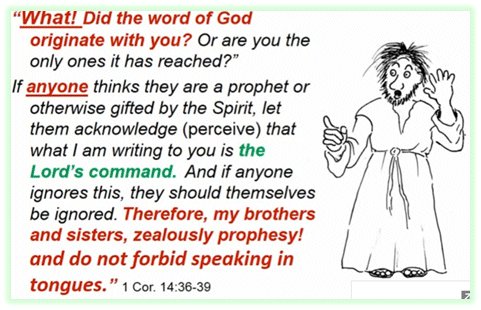
Pasted from Authority to Speak published 21-Feb-2015 viewed 30-Apr-2015
The Translation of Adelphos and Adelphoi by Michael D. Marlowe, 2004
http://www.bible-researcher.com/adelphos.html viewed 5/5/2015
"In conclusion, the Scriptures teach that at the Memorial Meeting i.e. 'in ecclesia', women should not teach
or lead the congregation in prayer. They should wear a head covering (and men should not) to symbolise the spiritual
relationship between God, Christ, man and woman. Instead of seeing the wearing of a covering by sisters as an outmoded
imposition, or worse, a symbol of male dominance, we should see in it a weekly reminder of the ecclesia's relationship
to Christ and a testament to our Heavenly Father's wisdom." GOD CHRIST MAN AND WOMAN, page 131.
Although the ecclesia of the O.T. and the ecclesia of the N.T. are different in the sense that the first was a national
entity with all of the laws and social structure necessary for such while the second comprises individuals drawn out of
the nations, there is a remarkable consistency between the Old and New Testaments on the role relationships of men and women.
…It was mentioned earlier in connection with the disturbances in the ecclesial meetings when some sisters were seeking
leading roles for themselves; but at that stage only the questions of headship and head coverings were addressed. Now,
as it was closely associated with the problem of the confusion arising from the abuse of the gift of tongues, Paul considers
the position of sisters when the ecclesia gathered together. It is apparent that they too were involved, and Paul follows
up with his comments about headship to talk specifically about the part sisters could play in ecclesial meetings Were they
included, for example, in the new arrangement that allowed the involvement of no more that two or three with a specific
spirit-gift?
Most marginal references direct the reader to Genesis 3:16 and God's words to Eve after her disobedience, "…Your desire
shall be for your husband, and he shall rule over you". (NKJV) This is also reinforced in the Law itself when it
deals with the subject of oaths. A woman's vow was subject to the control of her husband, or if she was unmarried, her
father (Numbers 30:3-8). That the Edenic situation provides the backdrop to all the apostle's comments about the position
of sisters is apparent on every occasion he refers to the subject (1 Corinthians 11 & 14; 1 Timothy 2). When he says,
"…it is shameful for women to speak in church" (1 Corinthians 14:35, NKJV),
we are being reminded of the shame felt by Adam and Eve when they discovered their nakedness. Paul wished to ensure that
sisters should not feel ashamed, or become exposed in ecclesial meetings, and therefore told them that the home is the
place for further and specific instruction.'
Sis. Robin then goes on to add confusion to 1 Corinthians 11:3 but notice her graphic (pasted below) does not include the verse she is quoting, which is verse 3. Also notice it is not even quoted correctly: " the head of every man is Christ, and the head of the woman is man, and the head of Christ is God." (NIV)
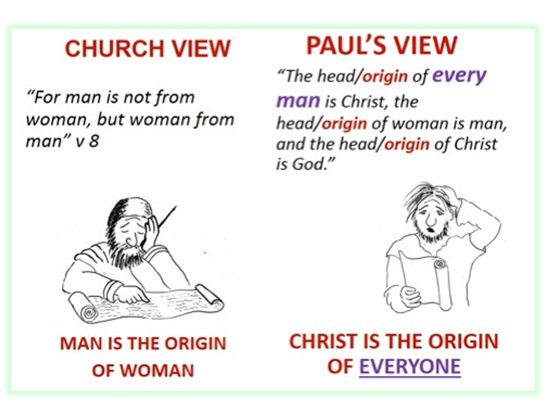
She then says that "every man" means "everyone", but it is abundantly clear that Paul is saying that God Christ Man Woman is the Divine order.
Clearly it says, "…and the head of woman is man" (NIV). Also note Christ is not the head (or origin 69) of God!! The NIV says in verse 12: "But everything comes from God."
Also there is no evidence that v. 8 is the "church view". Even the NIV has one paragraph from verse 3 to verse 10.
Notice Sis. Robin also ignores the obvious meaning of verse 9: "Neither was man created for the woman; but the woman for the man. 70
"The head of the ecclesia is Christ; collectively, we are his body. Using the typical language of marriage, Christ is the groom, and we are his bride. Every Christadelphian understands the Bible in this way. And no true Christadelphian divides the body or bride of Christ by gender, race or class. As Paul said, we are 'all one in Christ Jesus' (Gal 3:28) - equal in being in the image and likeness of God, equal in spiritual value and significance to God, equal in being called to dominion in the Kingdom of God through faith in the death and resurrection of Jesus Christ.
The head of the ecclesia as a whole is undoubtedly Christ, and we are collectively his body. Yet within the ecclesia the principle extends further, as Paul himself says: 'The head of every man is Christ, and the head of the woman is the man' (1 Cor. 11:3). By honouring these relationships, which God designed, we honour Christ as our head.
What Paul plainly says (1 Cor. 11:3; Eph. 5:23) is:
-
(1) God is the head of Christ
(2) Christ is the head of every man
(3) The man is the head of the woman.
It is not a matter of 'claiming' authority, as the questioner puts it, implying that the authority has been seized illegitimately. It is a matter of properly exercising the responsibility that has been invested in some people by the ecclesia as a whole. This was true in the first century (Luke 22:26; Acts 15:22; Rom. 12:8; 1 Thess. 5:12; 1 Tim. 5:17; Heb. 13:7, 17, 24), and it remains true today. To exercise responsibility in a proper manner is not to challenge Christ's headship, but to honour it by honouring God's arrangements. To challenge this arrangement is to challenge God's arrangements, and dishonour Christ the head."
Quoted from Responses to 27 questions from SistersSpeak
As for Sis. Robin's claim that the word kephalē should be translated as 'origin', the information linked here refutes that egalitarian claim.
68 It should be pointed out that Deborah refused to take the lead see footnote 66. (Footnote added by reviewer.)
69 Using Sis. Robin's meaning of kephalē, not what it means.
70 Additional note: An incorrect interpretation is plainly found in the NIV marginal rendering of vv 4-7. Much might be said to demonstrate how erroneous it is, but the best thing to do is simply to evaluate the alternative translation in the light of this exposition. Do so, and it will be evident that there is scarcely a significant Greek word that is fairly treated in the alternate rendering.
- 1 Cor. 14:40
- "But let all things be done properly and in an orderly manner"
Ecstatic gibberish spoken in a highly emotional state is the exact opposite of the Apostle's command, as anyone who has witnessed the modern Pentecostal phenomena can testify. To conduct worship "decently" is to make a pleasing impression on all who are right-minded. "In an orderly manner" reminds one of a marching army as contrasted to a mob. The apostle here condemns any ecclesia acting independently of others, as well as a member acting from fleshly impulses without regard to others.