
Home
Preface
Abbreviations Used
Introduction
General Subjects
Exposition
Matthew
Mark
Luke
John
John 14-16
Acts
Romans
1 Corinthians
2 Corinthians
Galatians
Ephesians
Philippians
Colossians
1 & 2 Thess.
1 & 2 Timothy
Titus
Hebrews
James
1 & 2 Peter
1 John
Jude
Revelation
Gifts of the Spirit
Inter-Ecclesial Offices
Word Studies
Bibliography
Index
Epilogue Acknowledgements
The Continuing Acts of Jesus by the Spirit through the Apostles
Luke introduces his remarks by reference to "the first account I composed". In that account now known as the gospel of Luke, he recorded "all that Jesus began to do and teach." By implication then, "Acts" is an account of what Jesus continued "to do and teach" after his ascension. We would therefore, expect that "Acts" be full of occurrences of miracles of action and teaching (in the form of words rather than thoughts) caused by the Holy Spirit. Indeed, as we examine the book in detail we find that all occurrences of the Holy Spirit are of a miraculous character.
Luke, in the first few verses, introduces the fact that the Apostles were instructed "not to leave Jerusalem but to wait for what the Father had promised" (v. 4). They received this promise of the Father only ten days after the ascension of the glorified1 Christ. As Peter pointed out at that time, the pouring out was a partial fulfillment of that which had been prophesied by Joel (2:28-32). This reference by Peter clearly indicated the wide spread distribution of the Spirit. It was to be on "all flesh" without discrimination as to age, race, sex or position2. In clear unmistakable terms he told the gathered multitude that what they could "see" and "hear" (i.e. the tongues of fire and the gift of tongues) was (a) the outpouring promised in Joel, and (b) the Father's promise of the Holy Spirit. It is important to note that there is no place in Peter's inspired exposition of Joel or his explanation of the Father's promise to Jesus for the gift of the Holy Spirit constituting, or even including, what some call the spiritual graces of righteousness, peace or joy. Rather, his exposition and the rest of Luke's record of the "Acts" demonstrates that the Lord worked "to do and to teach" by three modes:
- by miraculous Spirit gifts3.
- through visitations of Angels4.
- by providential guidance without visible intervention5.
A. The miraculous spirit gifts
Even some of the passages which appear on the surface to teach a mystical indwelling causing peace and joy, are seen to teach otherwise when carefully examined.
For example:
"a man full of faith and of the Holy Spirit" (Acts 6:5) had the temporary Spirit gift
of faith ( 1 Cor. 12:9). Similarly, a man: "full of the Spirit and of wisdom" (Acts 6:3) possessed the temporary
intermittent gift of the word of wisdom (1 Cor. 12:8)6.
The miraculous was involved even in such passages as Acts 9:31:
"The ecclesias . . . walking in the comfort of the Holy Spirit".
The word for "comfort" is translated "exhortation" (Acts 13:15), and Luke was saying that the brethren were "walking . . . in the exhortation supplied by the Holy Spirit" through those who had the gift of exhortation (1 Cor. 14:3). The "guidance" provided to Barnabas and Saul (Acts 13:2) and to Paul and Silas (Acts 16:6-7) was not intuitive but came through the gift of prophecy7.
The table below is a rough quantitative tabulation of some types of miracles in Acts.
| THE WORK OF THE SPIRIT AS PROMISED IN JOEL | Textural references in Acts fulfilling these specific promises. |
| "Prophecy" in the sense of forthtelling or speaking Words of God, rather than solely foretelling (2:22; 3:12; 4:8,31; 9:31; 10:19,31; 11:12,21,27,28; 13:2,16; 15:13,28,31,32; 16:6,7; 17:2; 18:5; 20:2,18; 21:4,11) |
25 |
| "Visions" (7:55; 9:3,10,12,27; 10:3,11,17,30; 11:5,13; 16:9; 18:9; 22:6,17; 23:11) |
16 |
| "Wonders and signs" (2:2,3,4,43; 3:7; 4:14,31,33; 5:5,10,12,15-16; 6:8; 7:56; 8:6,13; 9:18,34,40; 10:44;13:11; 15:12; 16:26; 19:6,11; 20:12; 28:5,8) |
28 |
| THE WORK OF THE PARAKLETE AS PROMISED IN JOHN | |
| "Witness", prophetically and personally (4:33; 5:29,32; 6:10; 8:5,6,12,25,35; 13:52; 15:8; 22:1) |
11 |
| "Convicting" -- of sin (2:37; 4:4; 5:3,9; 7:51-54; 8:20; 10:6; 13:10,40; 16:29; 17:30; 18:6; 19:18; 24:25; 28:25-27 |
15 |
| -- of righteousness (2:37; 3:15; 4:10; 10:40; 13:30,34; 17:31) |
7 |
| -- of judgement (as listed below) |
9 |
| Defence before civil and ecclesiastical courts (4:6; 5:27; 6:12; 16:36; 18:14; 22:1; 23:1; 23:34; 26:1) |
9 |
'There are, of course, many other instances of the Holy Spirit at work in Acts. The present writers claim, however, that every instance of the "Holy Spirit" in "Acts" is of a miraculous character8'
B. Angels in "Acts"
This is another way that the "Spirit" operated as recorded in "Acts".
- ASCENSION OF CHRIST. "Two men stood by them in white apparel" (1:10). The disciples had not yet received the promise of the Lord.
- RELEASE OF APOSTLES FROM PRISON. "the angel of the Lord by night opened the prison doors" (5:19).
The Holy Spirit was not for the personal use of those who possessed it. That is why an Angel released them. - DIRECTION OF PHILIP TO MAN OF ETHIOPIA. "the angel of the Lord spake unto Philip" (8:26).
"Angelic intervention was used when there was no one available immediately and/or when the more evidently authoritative and powerful presence of an angel was essential to the particular circumstances9" - VISION TO CORNELIUS. "An angel of God coming in to him". (10:3)
Cornelius did not have the Spirit so an angel was used to reveal God s message. - VISION TO PETER "I have sent them" (10:20, cf. v. 3). reason (3).
- RELEASE OF PETER FROM PRISON (12:7) same reason as (2).
- SMITING OF HEROD FOR ACCEPTING GLORY DUE TO GOD.
"Immediately the angel of the Lord smote him" (12:23) same reason as (3). - COMFORT TO PAUL. "There stood by me this night the angel of God" (27:23 cf. 3:11) (reason 3).
C. Providence in "Acts"
God also controlled the lives of the Apostles by unseen angelic control by what we term "The Ways of Providence". This guidance did not come directly to the mind but indirectly in a way that the person did not realize. The persecution which arose over the death of Stephen must surely be seen as a means God used to get the disciples out of Jerusalem, to preach elsewhere. (8:1,4).
1 cf. notes on John 14:12, 16.
2 See Inter Ecclesial Offices - Apostles, Section E.
3 See the Spirit Gifts, Section D.
4 See the additional notes on the Parakletos, Section C.
5 See notes on Guidance, Section B.
6 Both these examples use a figure of speech called "hendiadys, in which two nouns connected by 'and' are used instead of one noun or a noun and an adjective" (Webster's unabridged).
7 In the first example there were Prophets present (cf. v. 1). In the second both had the gift of prophecy (cf. 15:32; 1 Thess. 1:5).
8 TEST, Whittaker & Carr, "Spirit" in the New Testament, Vol. 43, P. 185. For example see 8:39 "The Spirit of the Lord caught away Philip".
9 IBID, P. 186.
- Acts 2:4
- "And they ..."
It is uncertain to some whether "they" (v. 1) means the 12 Apostles or the 120 (1:15) disciples as there are arguments in favor of both. Arguments in favor of the 12 are as follows:
- What Jesus had promised in John 14:16 was limited to the Apostles (at least initially).
- The gathering which was instructed by Jesus not to leave Jerusalem but which was to wait until the Holy Spirit was given consisted of the 11 (1:2, 4, 8; cf. Luke 24:49).
- If we disregard the chapter division, we see that it is the 11 plus Matthias (v.26.) that is the subject.
- v. 7 indicates that the speakers in tongues were all Galileans. It is doubtful that the 120 were all Galileans.
- v. 14 records that Peter stood up among the eleven.
Arguments in favour of 120 are:
- The record begins, "And when they were all with one accord in one place" (Acts 2:1). This phrasing looks back to the earlier incident where the 120 in the Upper Room "all with one accord continued stedfastly in prayer." (1:14-15 RV).
- Before the Lord's ascension he said to "the eleven" . . and those that were with them . . . tarry ye in the city until ye be endued with power from on high. (Luke 24:33, 49).
- As the Apostles were the prominent ones and Peter the spokesman it is reasonable to expect that they would do the speaking.
- The Pentecost of the Gentiles records that it "fell upon all those who were listening to the message" "which have received the Holy Spirit just as we did" (Acts 10:45, 47 NASB). So again not just the leaders, but all.
Conclusion:
In view of the evidence for the 120 above, there can be no doubt that the Spirit descended on the entire assembly of 120, but we see later the Apostles had special powers as a result.
- "... were all filled ..."
The word pleroo (filled) replaces the word "baptism" of Spirit from here on.
- "... with the Holy Spirit ..."
The Spirit gift of tongues. If, however, the Apostles did not receive the other gifts on this occasion, it is difficult indeed to explain:
- why they didn't. The promise of Joel demands it and so does John 14-16.
- when they did.
- the fact that Peter's defence was the gift of prophecy as he quoted from the Psalms infallibly.
It seems better to see tongues here as only a sign of the baptism of the Holy Spirit. The other gifts must have been distributed on this occasion also.
- "... and began to speak with other tongues"1 (cf. Mark 16:17)
Tongue speaking in the first century ecclesia can be identified with foreign languages.
"Glossa" and "Dialektos" are used interchangeably by Luke. Stress is often placed on the Greek word glossa as if to imply that the word in the New Testament means ecstatic utterances. But a comparison of the two Greek words shows them to be used interchangeably in Acts 2. The miracle of this chapter rested on the fact that Galileans, who may never have studied foreign languages (Acts 4:13) were able to fluently speak these languages. Consider the following parallels in Acts 2.
- "And they were filled with the Holy Spirit, and began to speak with other tongues (glossa)". v.4.
- "Every man heard them speak in his own language (dialektos)".v. 6.
- "And how hear we every man in his own tongue2 (dialektos) wherein we were born?" v. 8.
- "We do hear them speak in our tongues (glossa) the wonderful works of God". v. 11.
Those who claim the "gift" today nearly always display it in a wild, emotional state. With eyes dilated and glassy and with a stiff wooden countenance they jerk up and down, uttering incoherent cries. On the day of Pentecost, however, the people heard the Apostles
"as the Spirit gave them utterance" ("as the Spirit was giving them the ability to speak out" mg NASB).
When one possessed the gift of tongues, it did not mean that he would be able to speak it at all times. It did not make him a linguist. The gift was intermittent as the NASB rendering suggests. Paul did not understand the "speech of Lycaonia" for example (Acts 14:11). Those gifted with the interpretation of tongues could understand, however. Note that Holy Spirit and Spirit are used interchangeably in this verse.
1 See notes a 1 Cor. 13:1; 14:21 and Section D – "Tongues". 2 language (NASB)
- Acts 2:8
- "And how hear we every man in our tongue, wherein we were born?"
In v. 9-11 we have 15 actual languages spoken by the Apostles under the power of the Holy Spirit. Those knowing each language could understand clearly what was said (cf. v. 6). For example, the Elamites would hear a Galilean fisherman giving a talk in Elamite, even though he had never learned the language. It is significant that among the peoples mentioned by Luke, are some whose languages show only dialect differences, suggesting that the gift of tongues enabled the possessor to reproduce these dialect faithfully to the amazement of the hearers.
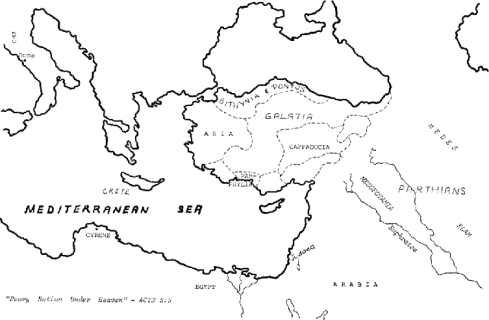 |
- Acts 2:17, 18
- "It shall come to pass in the last days, saith God, I will pour out my Spirit upon . . . your sons . . . and on my servants."
PROBLEM:
- This is a key Pentecostal verse, used to demonstrate present possession of the Spirit.
SOLUTION:
- If the context of the quotation is checked, it will be seen that it is beyond dispute that the primary fulfillment refers to a time still future when Christ is back on earth.
- .
- It is after the destruction of the Russian1 hordes:
"I will remove far off from you the northern army . . . and his stink shall come up." (Joel 2:20). - It is after Israel turns to the Lord:
"Ye shall know that I am in the midst of Israel. . ."
"and my people shall never be ashamed." (Joel 2:27). - After this "I will pour out my spirit". (Joel 2:28) (i.e. on mortal Judah).
- "In Jerusalem shall be deliverance." v. 32.
- It is after the destruction of the Russian1 hordes:
- What happened at Pentecost was a token fulfillment of Joel's prophecy. When the purpose of that token fulfillment was complete (the complete word of God) then the Spirit gifts ceased as Paul said they would. (1 Cor. 13:10).
- It is therefore foolish to use this verse to demonstrate present possession of the Holy Spirit in any form.
1 There is so much confusion about the "great and terrible day of the LORD" (v. 31) that it calls for comment here.
v. 31 is not describing the destruction of the northern Russian power (that is destroyed in v. 20) but of Roman Europe which will engage in a religious crusade against the "Antichrist". This is those who "shall make war with the Lamb" (Rev. 17:14). It cannot possibly refer to the destruction of Gog for it says that "in mount Zion and in Jerusalem shall be deliverance!" Zechariah promises that 2/3 of those in Jerusalem shall be destroyed by battle. The two do not refer to the same period. This destroys the theory expressed in NTTC!
- the pouring out of the gifts
- the signs in the heavenly bodies
- the opportunity of salvation
Preceding immediately the coming of the Lord . . . I'm not pressing the claim that this is what Joel is saying."
a) to the saints; b) to the world.
Neither of these offers "salvation" but only an opportunity to escape death at that time (Zech. 14:16a). Salvation is not instantaneous and never has been. These people will become subjects during the millennium, not the immortal saints.
- Acts 2:18
- "Even upon my bondslaves, both men and women"
This prophecy of Joel's applied to male and female, young and old (cf. 1:14). There seems to be a conflict here with Paul's teaching that women were not permitted to speak in the ecclesia. (1 Cor. 14:34, 35; 1 Tim. 2:11,12). Paul's teaching however, has reference to teaching or speaking in ecclesias but does not apply to prophesying outside such gatherings. Paul accepted the hospitality of Philip and his four prophetess daughters.
- "I will in those days pour forth My Spirit ..."
A partial fulfillment, which resulted in the gifts being demonstrated.
- "... and they shall prophesy ..."(cf. v. 11)
Tongues was prophecy in a foreign language whereas prophecy was forthtelling the gospel in a native language. This ability would last until the end of the Apostolic age.
- Acts 2:33
- ". . . having received from the Father the promise of the Holy Spirit".
Christ had promised the Parakletos in John 16:7; the Holy Spirit in Acts 1:4, 8. Jesus was the agent in whose name the Spirit gifts were sent, but he was never its original source. This manifestation could not be explained except on the basis of an exalted Saviour of whom the prophets had testified to his coming, his teaching, his death, his resurrection and now his exaltation. See John 7:39 also.
- "He has poured forth this which you both see and hear"
Both the peoples' eyes and ears could testify to the manifestation of the Spirit gift power. It was not inner and subjective.
- Acts 2:38,39
- "... ye shall receive the gift of the Holy Spirit1. For the promise is to you and to your children and to all that are afar off, even as many as the Lord our God shall call."
PROBLEM:
This verse is used in several ways which are incorrect.
- It is argued that the present day "Christian" is the one "afar off" and therefore this verse is justification to their claim to be able to work miracles such as the gift of healing and the gift of tongues.
- It is argued that the promise of the Spirit was to the believers for all time and that what Peter offered was
not the various gifts of the Spirit2 but an inner power which should work righteousness in them.
e.g. "The manifestations (miracles) . . . were the mere advertisement for something greater and more inward, as well as vastly more important . . . God still, without the outward signs, pours out the Spirit grace richly upon those that call upon him" (TCM Vol. 96). - It is argued that we have no evidence that those Jews received the miraculous gifts on their baptism. (NHSB, P. 11).
- It is argued that there is no evidence of the widespread nature of the Spirit gifts immediately following Pentecost.
The following was written by a Brother arguing for salvation being the gift of God. "One thing is certain: there is no indication that 3,000 people immediately received the power to work miracles. The record simply states that 'many wonders and signs were done by the apostles'."19
- It is argued that the power to work miracles was not what these penitent men were seeking for.
e.g. "Peter, while having the signs… was offering something more important than the signs themselves, the work of God to bring about salvation of the individual" (TCM, Vol. 96). - It is argued "that, if the miraculous gifts were indeed the subject of Peter's promise, provision would have
been made for their fading out5".
Because he did not it is claimed that what was promised was something non-miraculous. - It is argued that other `passages use the word "children" tekna in a much wider sense (than the second generation) as descendants, members of a race, or members of a community ... "Those who come after you" is the most likely meaning here'5.
- This verse is read by some so that "the gift of the Holy Spirit" [i.e. the Holy Spirit is the gift], is not that but rather something that the Holy Spirit has promised, i.e. salvation16, resurrection and immortality17, the knowledge of salvation18.
- It is argued that since charismata is not the word used in verse 38 it cannot refer to the miraculous gifts.
'As it is impossible to separate the Holy Spirit from this work, it is appropriate to describe resurrection and immortality as "the promise (or gift) of the Holy Spirit…"'
'This conclusion about the "gift of the Holy Spirit" in Acts 2 is reinforced by the words that are used. The usual word for spirit-gifts in the New Testament is charismata from which we get our word 'charismatic'. But this is not used in Acts 2. When those who were baptized were promised "the gift of the Holy Spirit", the word "gift" translates the Greek word dorea. 22
- It is agreed that the phrase "to you and your children" would imply that the promise is limited to two generations of Jews, but the next phrase, "to all that are afar off" does not limit the promise to two generations of Gentiles (Ephesians 2:13, 17). Like the third phrase, "even as many as the Lord our God shall call" it is open ended . . .'
- So what is the "promise"?
The context of Joel's words, which Peter is explaining, is salvation in the name of Jesus of Nazareth (Joel 2:11, 32). The context of Peter's speech is also salvation in the name of Jesus (Acts 2:21, 40, 47). It is unthinkable that the emphasis of the very first preaching of the gospel after the resurrection of Christ is how to receive the holy spirit rather than how to be saved in his name. Proof: 2 Peter 1:3-4; Galatians 3:14' 27.
SOLUTION I:
- The present Christian is "afar off" from the gospel if he thinks this! "The phrase in the Greek does not mean succeeding generations. It does not relate to time3."
- As clearly indicated in Solution II point 4, the phrase refers primarily to Gentiles who knew not the truth but would know it. They did receive the gifts.
- The gifts4 of healings and tongues are not in evidence today because their purpose was fulfilled and they are not available today. Faith healers can only cure psychosomatic illnesses and those who claim to speak in tongues simply cannot.
SOLUTION II:
- The context demands that the promise of the "gift of the Holy Spirit" was the fulfillment of the promise of Jesus "tarry ye . . . until ye be endued with power from on high." (Luke 24:49) and that fulfillment was in the form of a God given ability to speak in "tongues". This was an outstanding miracle and the people recognized this. Peter connects this outpouring of the Holy Spirit with the "promise" in v. 33.
- The immediate context of v. 39 cannot be separated from v. 33 which describes miracles. To do so is a wresting of
scripture. The parallel between verses 31 - 33 and 38 - 39 is very evident.
- V. 31 describes:
(1) the death and
(2) the resurrection of Christ.
V. 33 describes:
(3) his exaltation to heaven and receipt of the Holy Spirit. - Verses 38 and 39 are a parallel illustration and show how the believer could identify himself with the experience
of Christ.
Baptism is:
(1) a symbolic death,
(2) and resurrection of a "new man" in Christ.
Christ would then pour "forth this which you both hear and see."
(3) The receipt of the Holy Spirit was a mark of approval (cf. Acts 11:17) and showed that God had exalted them to "heavenly places in Christ". - Acts 10:43 - 48 is an obvious parallel to Acts 2:37 - 38.
repentance Brethren what shall we do (37) Cornelius, thy prayer is heard (31) baptism baptized (38) baptized (48) forgiveness of sins (38) remission of sins (43) receive Holy Spirit gift as sign of approval (38) Can any man forbid water (to) these which have received the Holy Spirit (44 - 47) This Holy Spirit was the ability to speak in tongues; not some mysterious nonentity.
- V. 31 describes:
- A comparison of the various uses of the words "the gift of the Holy Spirit6" in Acts shows that it always refers to the miraculous gifts of the Spirit.
- The promise of the Holy Spirit was not to believers for all time but:
(1) "to you (old men of Joel 2:28) and your children" (your sons, daughters of Joel 2:28) - the Jews gathered for Pentecost.
(2) "to all that are afar off" (cf. "all flesh" of Joel 2:28) refers primarily to the Gentiles as an examination of Eph. 2:17 (cf. Eph 3:5-8) and Acts 22:21 will show.
We do not doubt the power of inspiration to move Peter to speak things he did not understand. It is probable at this point that Peter's vision was limited and did not extend to the question of salvation for the Gentiles (cf. ch. 10). To him then "those afar off" would probably have been thought of as those of the Dispersion. Two scriptures support this idea:
"unto all Israel, that are near and that are far off". (Dan. 9:7).
"Mordecai . . . sent letters unto all the Jews that were in all the provinces of the king Ahasuerus, both nigh and far" (Est. 9:20).
Peter was addressing the "men of Israel" (Acts 2:22) but that does not preclude his words going farther than he understood, and including Gentiles. Scripture shows that the Gentiles did receive the gifts of the Holy Spirit. (1 Cor. and the family of Cornelius are examples.) There is nothing in this passage to indicate how long this promise would last. Other scriptures7 however, show that these gifts would only last until the canon was completed.
- The "gift of the Holy Spirit" was given to witness for the Lord; to convince, convert and upbuild other men and
women, and not to exert a personal (mystical) influence on the mind of those who possessed it. (Nor would the crowd Peter
spoke to expect such a happening!)
The witness of those newly endowed with the Spirit and returned to their respective countries was a very effective way, arranged by the providence of God by which the truth should have an initial spreading abroad.
- Perhaps the words of Paul give a fuller explanation to the brief words of Peter8. By the Holy Spirit,
both Jew and Gentile have access to the Father, and will become a habitation of the Father.
"And that he might reconcile both9 unto God in one body by the cross having slain the enmity thereby: and came and preached peace to you which were afar off." RV
"in whom the whole building being fitted together is growing into a holy temple in the Lord; in whom you also are being built together into a dwelling of God in10 the Spirit." (Eph. 2:16, 21, 22. NASB).
Perhaps Peter is also referring ahead to this time when the gift of the Holy Spirit to the believer will be a Spirit nature.
- It can be seen, therefore, that Acts 2:39 is not talking about a continuing gift of the Spirit in the hearts of the believers from Pentecost down to our time11.
SOLUTION III:
- The Problem states a partial truth. On the other hand there is no suggestion that any direct activity of the Spirit occurred.
- When Paul went to Corinth (Acts 18), "Crispus, the chief ruler of the synagogue, believed on the Lord with all his house; and many of the Corinthians hearing believed, and were baptized" (v. 8). Although the promise was unto all that were afar off, yet there is no mention at all of the Holy Spirit coming to these believers. Yet we know that many (if not all) in the ecclesia at Corinth did possess miraculous gifts. Because there is no direct evidence to the effect in Acts 18 we cannot assume that no miracle-working gifts were sent to the Corinthians.
- When Paul came to Ephesus (Acts 19) he found a Jew, Apollos, with some followers. Paul asked whether they had
received the Holy Spirit after they had believed. We notice how that Paul expected that they would have received the Holy
Spirit. What did Paul expect that they would have received? Miraculous gifts, or some Spirit activity to help in good
living? Note the words:
"And when Paul had laid his hands upon them, the Holy Spirit came on them; and they spake with tongues, and prophesied." (v. 6)
This is probably what Paul expected they would possess when he asked the question. Evidence that the Spirit had been poured out on the Apostles was the fact that they spoke in tongues. There is not the slightest suggestion in Acts 2 that the initial bestowal of the gift of the Spirit had any other effect.
SOLUTION IV:
- It is right to say that there is no evidence given in the form of examples immediately following Pentecost but it is wrong to say there is no evidence of miracles being meant12 in this context. There is, of course, no reason to expect concrete evidence. The theme of Acts is the spread of the gospel to the Gentiles and little is said about the early days of the ecclesia.
- When we come to the epistles13 in which ecclesial Problems are discussed, we have abundant evidence of the widespread nature of the Spirit gifts. Hebrews 6:4-5 confirms this evidence.
- When we place the above explanation in juxtaposition to the Problem we find a parallel and a contrast:
- a parallel in that there is no evidence in the form of examples in the immediate context that the Spirit came in a form to help believers to be righteous.
- a contrast in that there is no Scriptural evidence elsewhere for it being something which "helped them live acceptable lives".
- The only reason that the statement in Problem IV has any validity is because of the word "immediately".
We have demonstrated in the introduction that the 120 received the gift of the Spirit yet it seems that only the 12 apostles spoke in tongues and Peter alone used the gift of prophecy. This can easily be explained by the fact that the Apostles were the leaders. (Acts is largely a narrative about two Apostles Peter; ch. 1-12 and Paul; ch. 13 to end. The last 8 concern only Paul).
Shortly after Pentecost there is much evidence of miracles being performed by those who were not Apostles.
Only miraculous gifts were promised and only these were given.
SOLUTION V:
- It is true that these believers did not seek the ability to work miracles or they would have had "neither part nor lot in this matter: for thy heart is not right in the sight of God." Conversely it is not true that they sought for something unavailable to them or anyone else. They sought forgiveness of sins and would have welcomed the opportunity to spread this gospel to others. To that end they were given the gifts to assist them to witness for Christ.
- The gift of the Holy Spirit was something that came to them as believers and not something that came to create in them believing hearts. Enlightenment came to them by the word of God so expounded that the divine purpose was made plain and their obligation brought home to them. Peter did not say "You have been the subject of a divine operation by the exercise of God's power directly upon your minds" - he did say "Repent" or change your mind.
- To see v. 39 as describing bestowal of an inner power which would work righteousness in them is to:
- go beyond the facts of the verse.
- suppose that God cannot impute righteousness to a man forgiven of his sins in baptism and who strives to obey the Gospel.
- make a statement that is not in accordance with Scriptural testimony. The bestowal of the gifts did not cause righteousness.14 Nor does or did God bestow something that would directly cause righteousness. To have done so would have removed "free will" from the believer's life.
- To emphasize that the gifts were not what they needed, and that some source of inner strength and comfort was required, is to impose our thinking upon the chapter. That they needed strength and comfort no one doubts. To suggest from these words that this came directly to their hearts through the gift of the Spirit is very bad exposition. We know that the miraculous gifts of the Spirit were necessary for the growth and edification of the early ecclesias, but it did not operate directly but indirectly through men who spoke the revelations theyreceived. Who then are we, to doubt that this is the phenomenon to which these words refer? To suggest that the description of the believers' joy and fellowship in 41 - 47 is evidence of 'the inward reality of the Spirit' is of no relevance. The Samaritans had a similar experience before they received the Holy Spirit (8:8). There are also other instances where, significantly, there is no mention of the gift of the Spirit, e.g. Acts 8:39; 16:34.
- On the day of Pentecost the converts had witnessed the double miracle of "prophecy", quoting Psalms infallibly,
and "tongues", translating them into the many foreign dialects of the Dispersion. To these Jews, still stunned by the
sudden realisation that Jesus of Nazareth was indeed their Messiah, and that he had been raised from the dead and exalted
to God's right hand to be a Prince and a Saviour, there would be nothing to suggest that the Holy Spirit could be anything
but the power behind all the staggering events and the marvels they had just witnessed. Nothing could be further from
their minds than the idea that the promised Holy Spirit was primarily a transforming inward grace, especially since
Peter had given no hint of it in his speech, and after their baptism "many 'wonders and signs' (Joel 2) were (still
being) done by the apostles" (2:43). They had been convinced, convicted, and converted by the indisputable fact of
supernatural events. As each of the 3,000 received one of the gifts by the laying on of the hands of the apostles, the
scope of the outpouring gradually widened. The Lord himself, in his infinite wisdom, was "distributing (the gifts)
severally as he willed" (1 Cor. 12:11), so that each bestowal was no doubt suited to the future role of its recipient
(see Testimony, July 1973, pp. 256-7). And the converts' new life in Christ was vibrant with joy as they "continued
stedfastly in the apostles' teaching and fellowship (shared through the saving knowledge that came through that teaching)
and in prayers" (2:42).
Against such a background it is by no means "irrelevant" that the promise of the Spirit, in response to the agonised appeal "Men and brethren, what shall we do?", should be one of power, to perform miracles, and notably to prophesy. This conclusion has been dubbed "morally questionable", and yet the present writers honestly consider that the text allows of no other conclusion.15
SOLUTION VI:
- This argument at least allows that it is possible for Acts 2:38 to refer to miraculous gifts.
- The Problem is an argument from absence and is therefore invalid. The author of the Problem statement is found in the position of stating what Peter "would have" done. Does he know more than Peter?
- At this early stage of the outpouring of the gifts there is no reason to suppose that any exposition on the gifts should have included reference to "their fading out". The pattern is the opposite. When the Gentiles received the Holy Spirit (Acts 10) Peter did not say "You know these gifts are only temporary" nor is there any reason that he should have. Also when Paul gave the gifts to the Ephesians (Acts 19) he did not say they would cease.
SOLUTION VII:
- The word is "teknon" (B), (S), (V), (Y) not tekna!
It occurs 99 times (Y) and has quite a variety of meanings. The argument expressed in the Problem, therefore, proves nothing. Other passages may use the same word but that does not define the meaning here. - As demonstrated in Solution II point 4 "children" refers to the "sons and daughters" of Joel 2:28.
- In any case the prophecy concerns Jews. Where is the evidence of Jews receiving this so called "non-miraculous Spirit" for many generations? There is none!
SOLUTION VIII: Grammatical argument for the Holy Spirit as the Gift
- "gen., receive the Spirit as a gift, Acts 2:38." - Arndt & Gingrich, Dorea, Greek-English Lexicon of the New Testament and Other Early Christian Literature, p.210
- "With the epexegetical gen. of the thing given, the Holy (Spirit), Acts 2:38." - Thayer, Dorea, Greek-English Lexicon of the New Testament, p.161
- "In Acts 2:38, 'the gift of the Holy (Spirit)', the clause is epexegetical, the gift being the Holy (Spirit)..." - Vine, Expository Dictionary of New Testament Words, p.147
- "The genitive is appositional, as in v.33 the promise is the Holy Spirit, so here the gift is the Holy Spirit." - Lenski, The Acts Of The Apostles
- "of the Holy Spirit - this clause is an appositional genitive with 'the gift' and means 'the gift, namely, the Holy Spirit.'" - Kistemaker, Acts, New Testament Commentary, p.110
That the Spirit is the gift in Acts 2:38 is the general consensus of Greek scholars.
This grammatical argument agrees with the scriptures. In what follows we demonstrate that there are several equivalent Scriptural phrases in Acts which define what the phrase "the gift of the Holy Spirit" in Acts 2:38 means.
Acts 8:15 - "Who, when they were come down, prayed for them, that they might receive the Holy Spirit:
16 - "(For as yet [it, Diaglott] was fallen upon none of them: only they were baptized in the name of the Lord Jesus.)
17 - "Then laid they their hands on them, and they received the Holy Spirit.
18 - "And when Simon saw that through laying on of the apostles' hands the Holy Spirit was given, he offered them money,"Acts 8:20 - "But Peter said unto him, Thy money perish with thee, because thou hast thought that the gift of God may be purchased with money."
Acts 10:45 - "And they of the circumcision which believed were astonished, as many as came with Peter, because that on the Gentiles also was poured out the gift of the Holy Spirit.
Acts 11:15 - "And as I began to speak, the Holy Spirit fell on them, as on us at the beginning.
16 - "Then remembered I the word of the Lord, how that he said, John indeed baptized with water; but ye shall be baptized with the Holy Spirit.
17 - "Forasmuch then as God gave them the like gift as he did unto us, who believed on the Lord Jesus Christ;Acts 2:4 - "And they were all filled with the Holy Spirit, and began to speak with other tongues, as the Spirit gave them utterance.
As we can see from these comparable events in the equivalence table below, the description is slightly different but the overall meaning is the same.
So
"the gift dorea of the Holy Spirit" (Acts 2:38)in these contexts.= "the Holy Spirit" (Acts 8:15, 17,18)
= "the gift dorea of God" (Acts 8:20)
= "the gift dorea of the Holy Spirit" (Acts 10:45)
= "the Holy Spirit" (Acts 11:15, 16)
= "the like gift dorea" (Acts 11:17)
= "the Holy Spirit" (Acts 2:4)
Summary:
In Joel 2:28-32 we find two promises:See also dorea under Word Studies which proves that 8 out of 11 occurrences refer to the miraculous gifts.
- The Spirit gifts would be given but two gifts only are mentioned out of the total of 11 20 given on the day of Pentecost --
- the pouring out of the Spirit with resulting prophecy and
- visions or dreams.
- The promise of salvation to those who heeded God's call. However the second is found in Acts 2:21 and confirmed in verse 47, but verse 38 does not mention it as we have seen above.
It must be admitted that the primary goal is salvation, but the wonder and commotion was caused by miraculous gifts poured out on the 120 which became the rule, apart from exceptions like Simon (Acts 8:18-21) and those who had not been visited by the Apostles after they were baptised. 21
But salvation is not an actual fact until after the judgment. We have many Biblical statements that define our life in Christ as a probation. Here are some samples:
"... he that endureth to the end shall be saved." (Matt. 10:22)"Take heed, brethren, lest there be in any of you an evil heart of unbelief, in departing from the living God. But exhort one another daily, while it is called to day; lest any of you be hardened through the deceitfulness of sin. For we are made partakers of Christ, if we hold the beginning of our confidence stedfast unto the end;" (Heb. 3:12-14).
"but I pommel my body and subdue it, lest after preaching to others I myself should be disqualified" (1 Cor. 9:27, RSV).
We hope for salvation and if we continue in well doing, in God's mercy, we shall receive the crown of life.
There are many examples in the New Testament of those who failed after accepting the gospel and being baptized, so "the knowledge of salvation" is not a present "reality". Paul states the general principle even of those who possessed one of the gifts, which did not make the recipient righteous:
"For it is impossible for those who were once enlightened, and have tasted of the heavenly gift, and were made partakers of the Holy Spirit, And have tasted the good word of God, and the powers of the world to come, If they shall fall away, to renew them again unto repentance; seeing they crucify to themselves the Son of God afresh," (Heb. 6:4-6).
SOLUTION IX:
- The argument that the Greek word charismata is not the word used in Acts 2:38,39 so therefore dorea cannot refer to the Spirit gifts is a red herring23 since the word charisma or charismata is never used in Acts.24 Yet it is obvious that the Spirit gifts are mentioned many times in Acts.
- See Solution VIII above for the evidence from Acts.
- Bro. Thomas wrote a couple of pages in Eureka which expresses the same view as we have done for the phrase
"and ye shall receive the gift of the Holy Spirit" --
'. . . They were now immersed believers of the things concerning the kingdom of the Deity and the Name of Jesus Christ (Acts 2:38; 8:12). . . It can easily be conceived what an excitement would be created in the Jewish community of Rome. They would, of course, tell the story of what they had seen, heard, and done; but, from the temper of the Jews in those days, we may know that, if they had no other evidence than their own assertion, they would be accused of falsehood and blasphemy; and accounted as worthy of a like fate with the Nazarene. But, the Spirit in Jerusalem had provided for such an eventuality in Rome and elsewhere. He knew that "the Jews, devout men, from every nation under heaven," after the feasts were over, would have to return to their several countries and friends; and he knew also, that such extraordinary facts and doctrines as he had prepared for mankind, required no less than the attestation of Deity in his cooperation with his witnesses. Hence, he not only moved Peter to specify the condition upon which believers of the Gospel of the Kingdom might be loosed from all past sins; but he moved him also to promise the baptized "the gift of the Holy Spirit." Filled sufficiently with this, they would be prepared for any emergency that might arise.
'What, then, was necessary to equip these new converts for the work of introducing the gospel of Jesus Christ among the Jews of Rome? . . . In short, it was necessary, that they should have all "the diversities of gifts" constituting "the Manifestation of the Spirit;" such as the word of wisdom, the word of knowledge, faith as it were, to remove mountains, gifts of healing, the working of miracles, prophecy, discerning of spirits, diverse kinds of tongues, and the interpretation of tongues (1 Cor. 12:4-10). Now, these gifts they would no doubt receive by the imposition of the hands of Peter, after the manner recorded of him, when the apostles sent him and John down to Samaria for a like purpose; who, when they arrived, "prayed for them that they might receive holy spirit: then laid they hands upon them and they received holy spirit" (Acts 8:15-17). In this way the gifts were imparted when apostolically and evangelistically bestowed.' 28
- The following by John Carter also agrees with the view expressed.
'The above interpretation of Acts 2 is endorsed in another way when we examine the words, "Ye shall receive the gift of the Holy Spirit." The word "gift" occurs in all eleven times, and of these, four are in Acts. The first
- ) is Acts 2:38. The other references are:
- ) Acts 8:20. Here Peter rebukes Simon for offering to buy the power to confer the gift of the Holy Spirit. The Samaritans had believed and had been baptized, but Philip evidently could not confer the Holy Spirit. The word was preached and they were baptized or "born again". When Peter and John went down to Samaria they "prayed for them that they might receive the Holy Spirit", and when the apostles laid their hands on them "they received the Holy Spirit". The bestowal of the Holy Spirit was subsequent to their baptism, and had nothing to do with their "birth" into Christ; they were already in Christ. It clearly was an open manifestation of the Spirit that they received.
- and iv.) Acts 10:45, 5729. Luke describes the outpouring of the Spirit on Cornelius.
"On the Gentiles [also] was poured out the gift of the Holy Spirit", and this is described as a parallel experience to Pentecost: they had "received the Holy Spirit as well as we", "as on us at the beginning". This outpouring was visible and miraculous: it followed the preaching, and it was given in this case to confirm that God had granted the Gentiles "repentance unto life". "God", said Peter, "gave them the like gift as he did unto us. [11:17]:"
On all these three occasions where Luke refers to the gift of the Holy Spirit, it is to the miraculous outpouring. Would he think of anything different when he summarized Peter's words in Acts 2:38? What else could Peter's hearers think he meant when they had before them evidence that the Spirit had been given to Peter and the rest of the apostles? They had no experience of any other, and no teaching of anything other, than possession that conferred some power either to say or do wonderful things. Not only so, when the word "gift" occurs elsewhere in the epistles in connection with the Spirit it refers to visible manifestation of the power of God. In Eph. 3:7 it is connected with the effectual working of God's power in Paul. In Eph. 4:7 it clearly has reference to the "gifts" of Spirit guided men, verses 8 and 11. In Heb. 6:4 it is connected with the powers of the age to come.'30
- One could argue that 'since charismata is not used in Ephesians that the gifts are not referred to in that epistle'. But they most certainly are, especially in chapter 4:8,11 - which uses the word dorea in verse 7.
- Ephesians 1:13-14 proves the meaning of the promise in Acts 2:39. They were sealed25 with that Holy Spirit of promise, which is the earnest26 of our inheritance.
SOLUTION X:
- If we reread Acts 2:17 we see what the last phrase in verse 38 is referring to and since verse 39 is linked to
that by the word "For" it is obvious that the thought of the previous phrase is continued. "For" is translated from a
Greek conjunctive "gar" (Online Bible) which is a grammatical term meaning to join things. In this case it joins the
"promise" of the Holy Spirit gifts verse 38 to the recipients in verse 39. This is obvious from verse 17 also.
"And it shall come to pass in the last days, saith God, I will pour out of my Spirit upon all flesh: and your sons and your daughters shall prophesy, and your young men shall see visions, and your old men shall dream dreams:"
- The sequence in Joel and verse 17 is reversed to that of verse 39. Joel first lists "all flesh" which includes the Gentiles, "to all that are afar off" of Acts 2:39, and this is limited and explained by the Apostle in that next phrase "even as many as the Lord our God shall call". Why do we say this is limited? Well the phrase "all flesh" in Joel and Acts 2:17 sounds like everybody was given this promise of the Spirit by Joel but of course it was only those whom God called that got the gifts, not everybody!
- Then there is the additional and obviously more important matter -- yet to be realized -- mentioned by Peter in
verse 21 which is very close to the meaning of Joel 2:28.
"And it shall come to pass, that whosoever shall call on the name of the Lord shall be saved".
Yes, salvation was promised by God through his prophets Joel and Peter31 plus this included for believers, in most of the first century, the Holy Spirit gifts. The latter cannot be eradicated from the sense of Acts 2:38 & 39. - Now read Solution II32 especially point 4 and related footnotes.
- Ephesians 4:13 especially limits the outpoural of the gift (dorea) seen in v11 to "till we all some in the unity of the faith and of the knowledge of the Son of God . . .". Yes this includes "love" (v16), but how could this "knowledge" especially & unity be achieved without the completion of the Scriptures if the gifts were no longer around? Basically that is a rhetorical question. It could not.
- As far as Eph. 2:13, 17 is concerned that does not prove the point raised in problem II. The letter has to be taken as a whole and cannot be limited to these verses. The following verses 1:13, 14, 17; 3:5, 7, 19 demonstrate this.
- The phrase "even as many as the Lord our God shall call" is limiting, not open ended, as explained above, and by the fact that the gifts ceased after the completion of the New Testament when John died.
SOLUTION XI:
- See point 3 in Solution IX. Bro Thomas' words capture the drama of the occasion.
- The first thing mentioned by Luke on the day of Pentecost and experienced by the 120 was the mighty wind and tongues of fire which came before Peter preached the gospel.
- The first thing specifically mentioned on this subject by Joel33 and repeated by Peter in Acts 2:17-19 is the dramatic outpoural of the gifts of the Spirit.
- It should therefore be clearly noted that Acts 2:21 comes after verses 17-19, not before.
- Almost all who were baptised got the gifts of the Spirit34 to assist them in their ecclesial/inter-ecclesial
duties or to preach salvation to as many as God would call. This is proved by such verses as 1 Cor. 12:7.
"But to each one is given the manifestation of the Spirit for the common good
For by one Spirit we were all baptized into one body, . . . and we were all made to drink of one Spirit." (NASB) - Galatians 3:14 cannot legitimately be extracted from the context where in verses 2, 3 and 5 it is obvious Paul is referring to the Spirit gifts which enabled them to "work miracles".
- There are at least 69 references in Acts alone to the fulfillment of the prophecy of Joel (though some of these incidents are referred to more than once in the text of acts. It was a work of the Holy Spirit in Prophecy, Visions and Wonders and Signs.35 'There are, of course, many other instances of the Holy Spirit at work in Acts. The present writers claim, however, that every instance of the "Holy Spirit" in "Acts" is of a miraculous character.' 36
- A 21st century Christadelphian might believe that it was "unthinkable" but the above are the facts.
1 cf. notes on v.18 Point 2 and footnote.
2 It is argued that this is so because there is no mention of miracles in this verse. See TBSM, Vol. 1 for a complete answer to this Problem.
3 I. Leask "Acts of the Apostles" (Durban North, S. Africa, P.O. Box 6056, 1969, P. 59).
4 See Section D. - The Spirit Gifts.
5 NHSB P. 18 footnote 4.
6 cf. Acts 8:20; Acts 10:45; 11:17.
7 1 Cor. 13:10; Eph. 4:13.
8 It is certainly true that in the first century the Holy Spirit was "given as a pledge of our inheritance". (Eph. 1:14).
9 Jew and Gentile.
10 "through" (AV)
11 see TEST, Carr & Whittaker, From Pentecost through the Acts, 1973, P. 183-184. This is denied by some (NTTC) but denial is not proof. Nor is the "to all generations" (Eph. 3:21) an indication of who is meant by "As many as the Lord our God shall call." This refers to those who give glory to God. It is not necessary to have the Spirit to give glory!
It is important to note that there is no place in Peter's inspired exposition of Joel or his explanation of the Father's promise to Jesus for the gift of the Holy Spirit consisting, or even including such "spiritual graces" as righteousness, peace or joy.
12 See Solution II
13 See exposition on Corinthians.
14 cf. Section B, "Did not cause righteousness".
The "free gift" and the "gift of righteousness" (Rom. 5:15,17) is not parallel to "the gift of the Holy Spirit". The former is what the hearers of the gospel were made aware of (i.e. eternal life). They were made aware of this "gift" by listening to the Gospel which was preached by those who possessed the "gifts of the Spirit."
15 The above is from TEST, Vol. 45, P. 164.
16 Paul Cresswell, Acts, The Christadelphian.
17 M. Ashton, The Challenge of Corinthians, CMPA 2006.
18 Don Harrison, The Testimony, Dec. 2006.
19 Don Harrison, The Testimony, Vol. 59, p. 452.
20 See section D.
21 See proof at Acts 2:41 and 4:4 below.
22 M. Ashton, The Challenge of Corinthians, CMPA 2006, p. 122.
23 A "red herring" argument is one that distracts the audience from the issue in question through the introduction of some irrelevancy.
24 If one wanted to they could use the same argument in reverse, saying that 'in Romans it does not mean Spirit gifts on 3 occasions so therefore in Corinthians it does not mean that', but that argument is a red herring also. For example the word charisma occurs in Rom. 5:15, 16 meaning God's mercy and forgiveness and 6:23 it is defined as "eternal life".
25 "The word 'sealed' in the Greek is a mercantile term that referred to the distinctive mark used for identification of ownership. Thus, when Christians exercised their Spirit gifts in public they showed to the world that they bore the stamp of God", TEST, V. 43, P. 228.
26 "Earnest" = Grk. arrhabon = pledge (Y and NASB), installment. It was similar to our "deposit" or down payment (NASB mg). It was not a continuing subsidy. It is, therefore, not reasonable to cite Acts 2:39 in claiming "continued possession of the Spirit". (It was a guarantee (2 Cor. 5:5. RSV), cf. 2 Cor. 1:22.)
27 Paul Cresswell, 1 page summary sent to me in June 2011.
28 Eureka Vol III, pages 229-231.
29 There an obvious typo in this quote, but it does not make the conclusion invalid. The fourth occurrence should be 11:17, which we have added at the end.
30 c1959. The Christadelphian, volume 96. (electronic ed.). Logos Library System (Vol. 96, Page 203). Birmingham: Christadelphian Magazine & Publishing Association.
31 As well as several others.
32 Point 7 of Solution II is not relevant to the problem expressed in problem X.
33 To claim that Joel is describing salvation in the name of Jesus in chapter 2:11 is a bit of a long shot. The word "abide" does not mean salvation, as a look at the following will establish. If it was as important to the context of the day of Pentecost as claimed why then does Peter not mention this verse?
3557 kuwl kool
a primitive root; TWOT - 962; v
KJV - contain 6, feed 6, sustain 4, abide 3, nourish 3, hold 2, receive 2, victual 2, bear 1, comprehended 1, misc 7; 37
1) to seize, contain, measure
1a) (Qal) to measure, calculate
1b) (Pilpel) to sustain, maintain, contain
1b1) to sustain, support, nourish
1b2) to contain, hold in, restrain
1b3) to support, endure
1c) (Polpal) to be supplied
1d) (Hilpil) to contain, hold, hold in, endure
1d1) to contain
1d2) to sustain, endure
35 See table above just below A. The miraculous spirit gifts.
36 TEST, Whittaker & Carr, "Spirit" in the New Testament, Vol. 43, P. 185. For example see 8:39 "The Spirit of the Lord caught away Philip" and their subsequent book Edward Whittaker & Reg Carr 'Spirit in the New Testament', Testimony 1985.
- Acts 2:41; 4:4
PROBLEM:
- Were the Spirit gifts given to few or many people?
"What was promised to those 3,000 who repented must have been promised likewise to the 5,000 of Acts 4:4. Did they each receive one of the Spirit gifts listed in the epistles? If they did then it would have been a phenomenon indeed for 8,000 people to be suddenly endowed with something like the gift of tongues or similar, and an outpouring on that scale just could not escape mention in the New Testament. But there is nothing recorded. With a few exceptions, we read only such things as 'Many wonders and signs were done by the apostles' (2:43)".1
SOLUTION:
- The answer is clearly implied in the second sentence above which although he does not seem to know it, is rhetorical.
- See the table on page 932 which lists 69 occurrences of the work of the Spirit in Acts as promised by Joel, and 51 occurrences of the work of the Parakletos as promised in John. And there are more.
- Far from there being "nothing recorded" about any widespread distribution of the Spirit gifts, the evidence is that
the possession of a miraculous gift of the Spirit was almost entirely the rule in the early first century
ecclesias not the exception,3 as the following passages show:
"And they of the circumcision which believed were astonished, as many as came with Peter, because that on the Gentiles also was poured out the gift of the Holy Spirit. For they heard them speak with tongues, and magnify God" (Acts 10:45,46).
"And when Paul had laid his hands upon them, the Holy Spirit came on them; and they spake with tongues, and prophesied. And all the men were about twelve" (19:6,7).
"And finding disciples, we tarried there seven days: who said to Paul through the Spirit, that he should not go up to Jerusalem" (21:4).
"Having then gifts differing according to the grace that is given to us, whether prophecy, let us prophesy according to the proportion of faith; or ministry, let us wait on our ministering: or he that teacheth, on teaching" (Rom. 12:6,7).
"that in every thing ye are enriched by him, in all utterance, and in all knowledge; even as the testimony of Christ was confirmed in you: so that ye come behind in no gift" (1 Cor. 1:5-7).
"but one and the same Spirit works all these things, distributing to each one individually just as He wills" (12:11, NASB).
"But covet earnestly the best gifts" (v. 31).
"Are ye so foolish? Having begun in the Spirit, are ye now made perfect by the flesh . . . He therefore that ministereth to you the Spirit, and worketh miracles among you, doeth he it by the works of the law, or by the hearing of faith?" (Gal. 3:3,5).
"But unto every one of us is given grace according to the measure of the gift of Christ . . . And he gave some, apostles; and some, prophets; and some, evangelists; and some, pastors and teachers; for the perfecting of the saints, for the work of the ministry, for the edifying of the body of Christ" (Eph. 4:7,11,12)4.
"As every man hath received the gift, even so minister the same one to another, as good stewards of the manifold grace of God" (1 Pet. 4:10).
"To you (old men of Joel 2:28) and your children ("your sons and daughters") and to those afar off [in distance, not time] ("all flesh" of Joel 2:28)" (Acts. 2:39). Does that sound like a few?
Acts 2:17 "And it shall come to pass in the last days, saith God, I will pour out of my Spirit upon all flesh: and your sons and your daughters shall prophesy, and your young men shall see visions, and your old men shall dream dreams:
18 And on my servants and on my handmaidens I will pour out in those days of my Spirit; and they shall prophesy:"
A few more from the books of Acts are added in what follows:
"Wherefore, brethren, look ye out among you seven men of honest report, full of the Holy Spirit and wisdom, whom we may appoint over this business ... And ... they chose Stephen, a man full of faith and of the Holy Spirit, and Philip, ... And Stephen, full of faith and power, did great wonders and miracles among the people. (Acts 6:3, 5, 8)
In explaining verses 3 & 6 Brethren Whittaker and Carr say, "they were selected because they were "full of the Holy Spirit and wisdom". By the figure of speech hendiadys...the phrase means they were chosen because they all had "Holy-Spirit wisdom", which was a special miraculous endowment (1 Cor. 12:8, etc) supplied to them by the Lord himself."5
Obviously Stephen had the miraculous gifts of faith and miracles as well. We need to bear this following statement
in mind when we discuss God's miraculous power poured out in the first century: "Now there are diversities of gifts,
but the same Spirit" (1 Cor. 12:4; cf. v. 9 & 10).
See also:
Acts 8:5 Philip did miracles and was an evangelist.
Acts 9:17 Ananias healed Saul's blindness and foretold his mission
Acts 11:19 Believers from Cyprus and Cyrene preached and the "hand of the Lord was with them"
Acts 11:27 "Prophets" came from Jerusalem to Antioch.
There is much evidence in Acts6 and especially the Epistles which proves that the miraculous7 gifts of the Spirit were received and used by many believers outside the circle of the Apostles.
Indeed the gifts were so widespread that the gift of discerning of Spirits was needed to determine the true possessor from the false claimant and to test them (1 Thess. 5:19-21; Rev. 2:2 etc.).8
PROBLEM:
-
"And, knowing human nature, if 8,000 people had been given miraculous powers, would not the apostles have had the problem of how to deal with a number of others who 'repented' simply in the hope of being able to perform some kind of miracle? Surely to promise a Spirit gift on the occasion of baptism would have sent out the wrong message".9
SOLUTION:
The example of Simon the sorcerer in Acts 8 answers this objection. Although he wanted the power of the apostles carte blanche to hand on the gifts, the principle is clear-he wanted the gifts for the wrong reason. God, the Lord Jesus Christ, and also the apostles (who had all the gifts), knew who were fakes and who wanted the gifts for the wrong reason. Thus Peter knew how to deal with Simon, possibly by the gift of discerning of spirits or the gift of knowledge. Simon's request was refused. Since the "Holy Spirit" (v. 18) or "gift of God" (v. 20) was given by the "laying on of the apostles' hands" (v. 18) he was told he had "no part nor lot in this matter". So receipt of the Holy Spirit gifts was not automatic at baptism. Obviously the believers at Samaria had to wait to receive the gift for some time until Peter and John got the message and made the journey there.10
CONCLUSION:
Let us not fall into the trap of inventing new theories because we simply have failed to read all the relevant scriptures and come to a Biblical conclusion. Certainly the gifts poured out on the multitude in Acts 2 were only temporary and partial in nature and the greater purpose was to enable some of the apostles to write the Scriptures and convince both Jews and Gentiles of the glory of the exalted Lord so they could have their sins forgiven and the hope of eternal life.
But, in acknowledging this, let us not forget that the gift of the Holy Spirit promised in Acts 2:38 was miraculous in nature (v. 33) and limited in time (v. 39). This is also what Joel prophesied, as we see in Acts 2:17,18, although it would not have been possible to have seen the gift of tongues in that prophecy per se unless Peter had made his inspired commentary. In the above analysis we have seen indisputably in a number of later Scriptures that what Peter promised, and what believers got, by the laying on of the apostles' hands was the same thing: a miraculous gift of the Holy Spirit, not salvation nor knowledge of salvation.
1 The Work of the Holy Spirit Testimony page 291, August 2006
2 http://www.christadelphia.org/books/spirit/Acts.htm
3 A significant proportion of those 3,000 that were given the gifts at Pentecost would have returned to their homeland and practiced their gifts in preaching the gospel. Exceptions would be where these, or where the Apostles had not visited after their baptism to impart them or after the Scriptures were completed.
4 Ephesians 1:13-14 proves the meaning of the promise in Acts 2:39.
5 On page 163-164 of Spirit in the New Testament published by the Testimony
6 Acts 1:15 and 2:4 says the 120 were all filled with the Holy Spirit. For proof that it was 120 see the comments on Acts 2:4 in my book or website mentioned in the footnote below.
7 It has been demonstrated repeatedly in the literature and by the authors mentioned herein that all the gifts of the Spirit were miraculous in nature.
8 Brother John Allfree's booklet (the subject of the review that brought forth the letter quoted) recommends on page 38 as additional reading three extensive expositions on the subject of the Spirit. The first of these, the excellent book published by The Testimony, Spirit in the New Testament by Brethren E. Whittaker and R. Carr, clearly demonstrates the widespread scope of the gifts of the Spirit in the first century ecclesias. The second book, The Spirit - A General Exposition of New Testament Usage, is available online at http://www.christadelphia.org/books/spirit/index.html, or in book form from the author, aleck@aussiebroadband.com.au. The third is The Holy Spirit by Graham Pearce.
9 The Testimony Nov. 2006, page 414
10 Apart from Pentecost (Acts 2), when Joel 2 had its incipient fulfilment, the 'Pentecost' of the Gentiles (10:44-46) and the example of Paul (9:17), this was the method of bestowing the Spirit gifts. See my exposition on Acts 9:17 on page 109 of the book referred to in footnote above.
- Acts 2:42
PROBLEM:
- There is nothing about continuing in the Holy Spirit.
SOLUTION:
This objection is clearly and contextually answered by the very next verse 43. Also Acts lists many of the very well-known operations of the Holy Spirit
- Acts 4:29-31;
- 8:15-20;
- 9:17;
- 10:44-45;
- 11:15-17;
- Acts 19:2-8.
- So do most of the epistles especially Corinthians & Ephesians
- Acts 5:9
- "Then Peter said to her, 'Why is it that you have agreed together to put the Spirit of the Lord to the test'?"
The AV "tempt" is not a valid translation because "God cannot be tempted" (James 1:13), and the same is obviously true of the Spirit of the Lord. She and her husband had decided to put the Holy Spirit under test to see if they could get away with it. The sin of Ananias was covetousness, lies, pride and double-mindedness.
By the gift of discerning of Spirits Peter knew they lied. By the gift of the miracles of judgement1 the sentence was pronounced and carried out. The result was the strengthening of the ecclesia (v. 5).
1 See Section D - "Miracles" (of judgement).
- Acts 5:32
- "We are witnesses of these things and so is the Holy Spirit which God gave to the ones obeying Him". (MARS) (cf. 15:28; Heb. 2:3, 4).
What a blow to the pride of the Sadducee - the fact that none of them had the gift of the Holy Spirit was an evident token that God was not with them. The disciples had the Holy Spirit gifts only because Christ had risen from the dead and ascended to God. He in turn gave them the gifts as a proof that Christ had triumphed over death and had ascended to the Father. (Eph. 4:8-10).
This verse demonstrates that the Holy Spirit was given to almost all converts in the first century in fulfillment of Acts 2:39. The tense used here shows that the meaning intended is continual obedience.
- Acts 6:5,6
- "They chose Stephen, a man full of faith and of the Holy Spirit . . . and these they brought before the Apostles; and after praying, they laid their hands on them."
PROBLEM:
- It is claimed* that Stephen and Philip were filled with the Holy1 Spirit before they were given miraculous powers by the laying on of hands of the Apostles and that therefore the miraculous powers were intended to fulfil a role separate from and subordinate to the supposed personal and inner non miraculous gift of the Holy Spirit.
SOLUTION:
- The assumption that the phrase "filled with the Holy Spirit" stands for an inward spiritual
grace or activity rather than miraculous powers is contradicted by the occurrences of the phrase elsewhere:
- "I have filled him (Bezaleel) with the Spirit of God" (Exod. 31:3) - a miraculous gift of "wisdom" for the construction of the Tabernacle.
- "He hath filled him (Bezaleel) with the Spirit of God" (Exod. 35:31).
- "Elizabeth was "filled with the Holy Spirit" (Luke 1:41) and prophesied, repeating, without knowing it, the Angel's salutation to Mary (Luke 1:28).
- "Zecharias was filled with the Holy Spirit and prophesied" (Luke 1:67).
- "Jesus, being full of the Holy Spirit..." (Luke 4:1) - following his baptism.
- "They (the 120) "were all filled with the Holy Spirit and began to speak with other tongues" (Acts 2:4).
- "Then Peter, filled with the Holy Spirit, said unto them, 'Ye rulers of the people'… " (Acts 4:8)
- by the spirit of prophecy (Mark 13:11).
- Stephen "being full of the Holy Spirit… saw the glory of God and Jesus standing on the right hand of God; and said . . ." (Acts 7:55-6) - this involved the gift of revelation or apocalypse (1 Cor. 14:6), and probably also of prophecy.
- There is clear textual proof that when Stephen and Philip were said to be "filled with the Holy Spirit" they had already received such spiritual gifts as the Lord judged were needful for the work that lay ahead of them. The choice of the seven deacons, including Stephen and Philip, was not a decision of merely human judgement. They were selected because they were "full of the Holy Spirit and wisdom". By the figure of speech hendiadys2 the phrase means they were chosen because they all had "Holy-Spirit wisdom", which was a special miraculous endowment (1 Cor. 12:8, etc.), supplied to them by the Lord himself.
- The ceremony of laying on of hands was practised in Israel for widely different reasons, and this must be taken
into account in the case of Stephen and Philip just cited. The ritual occurs:
- As a symbol of benediction (Gen. 48:14f; Matt. 19:13, 15, etc).
- As a symbol of the transfer of sin to a sacrifice (Exod. 29:10,15,19; Lev. 1:4, 12).
- As confirmation by witnesses on the head of persons charged with a capital offence (Lev. 24:14).
- As the outward sign of the delegation of, or appointment to some special office or assignment (Num. 8:10; Acts 6:6; 13:3).
- As an outward sign of healing (Matt. 9:18; Acts 9:12, 17).
- As an outward sign of imparting the Holy Spirit (Acts 8:17,19; 19:6; 1 Tim. 4:14; 2 Tim. 1:6).
The seven deacons received from the apostles a prophetic confirmation of their call, and a blessing on their work before they assumed their new responsibility, exactly as did Barnabas and Saul from prophets at Antioch before they started on their missionary work (Acts 13:3). It is therefore incorrect to say that Stephen and Philip did not possess any of the Spirit-gifts until the apostles laid their hands on them (Acts 6:6).'3 4
* NHSB, P. 11.
1 The text does not have Holy at v. 3. (NEST).
2 See Introduction to Acts footnote 6.
3 Compare the case of Joshua, of whom God said to Moses: "Take thee Joshua . . . a man in whom is the spirit, and lay thine hand upon him . . ." (Num. 27:18).
4 cf. TEST, Vol. 45, P. 166.
- Acts 8:15
- "Peter and John . . . prayed for them (Samaritans), that they might receive the Holy Spirit".
John was one of those who on an earlier occasion sought to call down fire upon the Samaritans (Luke 9:54-56). This record indicates that the Apostles alone could be the agents by which others received the Spirit gifts. The power to pass on the Holy Spirit rested with God. Philip could do miracles and signs but, not being an Apostle, he could not be the agent of transmission.
- Acts 8:16
- "for it had not yet fallen on any of them."
This demonstrates that the bestowal of the Holy Spirit was not automatic at baptism.
- "... but they had only been baptized in the name of the Lord Jesus" (RSV).
This is the same as "the name of Jesus Christ" (Acts 2:38).
The Apostles were concerned about how the Samaritans would fare in the absence of Philip, because there would be no one
to guide them in their study of God's word. The Solution was that they would be given the Holy Spirit so that they could
be guided by the gift of prophecy, knowledge etc., and so be built up or edified.
- Acts 8:17
- "Then they began laying their hands on them."
This act was a necessary part in imparting the Spirit. It was only through "the laying on of the Apostles' hands (that) the Holy Spirit was given" (v. 18).
- "... and they were receiving the Holy Spirit"
This divine gift was only given after some time had elapsed so that they would have had time to prove themselves worthy of such honour.
This power in the Samaritans must have been manifested otherwise how could Simon see (v. 18) that "the Holy Spirit was given"?
- Acts 8:18
- "Now when Simon saw that the Spirit was bestowed through the laying on of the apostles' hands, he offered them money," (NASB)
Philip had "preached the things concerning the kingdom of God..." but he could not pass on the Spirit. It required an Apostle1 like Peter or John (v. 14, 15).
1 Or Ananias (See next verse and especially the exposition at Acts 9:17).
- Acts 8:19
- "... Give this authority to me as well, so that everyone on whom I lay my hands may receive the Holy Spirit". (NASB)
In God's design only the Apostles (and a singular case of Ananias, who indirectly filled Saul "with the Holy Spirit", Acts 9:171) were to have this power2.
The historical period in which we are now living is between the former and latter rain and is a period of spiritual drought where the sun has gone down on the prophets and we are without the Holy Spirit to guide us, except in so far as the Spirit abides in the Word of God. The statement in v. 18 that only the Apostles (and a singular case of Ananias) could pass on the Holy Spirit is something people cannot answer when trying to prove that they have the Holy Spirit.
1 See exposition at this verse.
2 Apart from the Pentecost of the Gentiles (Acts. 10:44-47; 11:15-17) where it came directly from God (v. 17)
or Jesus (Acts. 2:33).
- Acts 9:17
- "And Ananias went his way putting his hands on him ..."
Putting = Grk. epitethemi = "laying his hands" (RSV). This does not always signify the bestowal of the Holy Spirit:
- In 6:6 the Apostles laid their hands upon the Seven but Stephen, is earlier described as "a man full of . . . the Holy Spirit". This was then an act of dedication or appointment to office.
- 13:3 presents another case. Both Barnabas and Saul not only possessed the Spirit (11:24; 9:17) but had already been appointed to the work (v.2). This action expressed union of intent.
- "... hath sent me, that thou mightest receive thy sight ..."
The emphasis of v. 12, v. 18 and 22:13 indicates that the primary purpose of the laying on of hands was for the recovery of sight. Healing was often accompanied by the laying on of hands (Luke 4:40; Mark 6:5; 16:18). Ananias was therefore probably exercising the gift of healing. (cf. 1 Cor. 12:9).
- "... and be filled with the Holy Spirit".
This is one of three occasions—apart from John the Baptist receiving the Spirit at his birth; and that of Jesus being baptized, and being given the Holy Spirit in the obvious sign of the dove and the voice from heaven—
- On the day of Pentecost when 120 including the Apostles directly by Christ (Acts 2)
- Ananias (indirectly though the laying on his hands gave the Holy Spirit to Saul/Paul (Acts 9:17)
- Pentecost of the Gentiles (Acts 10) directly
It is important to realize how significant this is, for in 2 Cor. 12:12, Paul substantiates his apostleship upon the ability to perform signs and wonders using the Holy Spirit gifts. In 1 Cor. 9:21 he states effectively the fact that the Corinthians had the gifts was evidence that he was an Apostle because he gave the gifts to them. The basis of the bestowal of the gifts has already been established2. It could be direct from heaven or indirectly through the hands of an Apostle. However, the person who received the gifts from an Apostle could not in turn pass them on. With this principle in mind, we can appreciate Paul's comments in Gal. 1:1, 11-12. He clearly emphasizes that he was an Apostle through Jesus Christ, and God the Father - and not of (DIA) or from (APO) man. It is significant that in this record, the role of Ananias in relation to the bestowal of the Holy Spirit is played down. Also, there is no mention here of the manifestation of the Holy Spirit as for example in 10:44; 19:6. The writer of Acts is, therefore, not intending to convey the idea that the Holy Spirit was transferred by an unknown Ananias. Such a role was Christ's alone.
What then was the role of Ananias? It is clear that he was associated with the reception of the Holy Spirit as this verse clearly implies it. The answer is that the power was not transferred from Ananias but came direct from the Lord in heaven as in the case of the other 12 Apostles.
The reason why one of the Apostles were not given the task is fairly obvious as Saul/Paul was the one who was killing the disciples.
A comparable event: At the baptism of Christ by John, the Holy Spirit came independently of John (Matt. 3:13-17).
1 see notes there. 2 see Section B - "Methods of Imparting the Spirit Gifts".
- Acts 9:31
- "So the ecclesia throughout all Judea and Galilee and Samaria enjoyed peace, being built up; and going on in the fear of the Lord ..."
Edification occurred by the operation of the gift of prophecy. (1 Cor. 14:3; Eph. 4: 11,12). "Fear of the Lord" may refer to the result of the miracle of judgement (Acts 5:1-9).
- "... and in the comfort of the Holy Spirit. . ."
Comfort (or consolatory exhortation) was made possible through the revelations given by those who had the gift of prophecy. This comfort (paraklesis) is a cognate with Parakletos1 (Comforter, AV) of John 14-16.
1 see Section F - Word Studies.
- Acts 10:44
- "While Peter was still speaking these words, the Holy Spirit fell upon all those who were listening . . ."
Cornelius was "a devout man and one that feared God . . ." (v.2). It must not, therefore, be assumed that the Spirit was given so that he could believe. The context says the very opposite. The Spirit gift of tongues was what "fell" on them. The reason is given in v.45.
- Acts 10:45
- "All the circumcised believers who had come with Peter were amazed ..."
"Circumcised" Jews did not expect the sharing of the promises with the Gentiles. The lesson had just been given to Peter through the vision and now the "circumcised", (along with Peter) were shocked by what they heard. They would be converted Jews after that.
- "... because the gift of the Holy Spirit had been poured out upon the Gentiles also".
This had been stated many times but the Jews found it difficult to accept.
- Acts 10:47
- "Surely no one can refuse water for these to be baptized who have received the Holy Spirit just as we"
The "we" possibly included six brethren who were accompanying Peter (Acts 11:12) but more likely it refers to Jews in contrast to Gentiles.
This miraculous manifestation was obvious to the circumcised that God had set His seal of approval on the Gentiles. It was bestowed before baptism to dispel any doubts. It was a sign given in most unusual circumstances for the Holy Spirit usually came upon baptized believers.
- Acts 11:12
- "And the Spirit told me to go with them without misgivings." (cf. 8:29; 10:19.)
Through the gift of prophecy this revelation was made to Peter.
- Acts 11:15
- "... the Holy Spirit fell upon them ..." (cf. 10:44).
The word "fell" indicated the origin of the gift of tongues. It was from above.
- "... just as upon us at the beginning"
The gift was the ability to speak in foreign languages just as it had been earlier at Pentecost. The "us" refers to Jews.
- Acts 11:16
- "you shall be baptized"
It is true that baptized is used here but this is a quote from chapter 1:5. This does not, therefore, negate the point already made on "pleroo".1
- "with the Holy Spirit"
These are the words of Jesus before his ascension. The "filling with the Holy Spirit" in Acts 2 was a fulfillment of that promise but here again was another manifestation of it. This being the case, Jesus' words must have applied to Gentiles as well as to Jewish believers.
1 see notes at Acts 2:4 - "filled".
- Acts 11:17
- "If God therefore gave to them the same gift ..." (cf. 15:8)
"There is neither Jew nor Greek, bond nor free, male nor female" but all are one in Christ Jesus.
- "... as to us also after believing in the Lord Jesus Christ ..."
It was therefore, not the Holy Spirit which caused the change of heart in the disciples. It was the resurrection. The state of acceptability rests on belief on the Lord Jesus Christ not on circumcision.
- Acts 13:4
- "so being sent out by the Holy Spirit".
The revelation (v. 2) would have to come through one of the prophets (v. 1). Here was a special commission to "proclaim the word of God" (v. 5) to the Gentiles. It was therefore the Divine Will that Barnabas and Saul were to do this work.
- Acts 13:52
- "And the disciples were filled with joy and with the Holy Spirit."
Persecution brings joy in most cases. (Matt. 5:12). The messages of edification given by Paul and Barnabas through the gifts of the Spirit would have added to the disciples' (converts, NEB) joy. (cf. also 1 Thess. 1:6). If we adopt the inference of the NEB (i.e. converts) the Problem is virtually removed. They would have been filled with joy because of what they heard.
"When the Gentiles heard this, they were (overjoyed, NEB) glad".
Because they believed and became converts, they would have received the Holy Spirit gifts, as promised in 2:38, 39. We must not, however, assume the joy came directly by receipt of the Spirit. Rather it developed within them from what they heard proclaimed by the Apostles.
- Acts 15:9
- "He made no distinction between us and them"- Jews and Gentiles.
"cleansing their hearts by faith"
(cf. 10:15, 43 not directly but indirectly). Cornelius was one who feared God (10:2).
"Faith cometh by hearing and hearing by the Word of God". (Rom. 10:17). God arranged circumstances so that Cornelius heard the gospel. The hearing produced faith and that in turn caused repentance. Because of this repentance they were baptized (10:48). Thus God imputed righteousness to them; therefore their hearts were cleansed. The whole operation was of God, but indirectly through the gospel.
- Acts 16:7
- "... the Spirit of Jesus1, did not permit them;"
We cannot be conclusive as to how this message came. Paul had the gift of prophecy (1 Thess. 1:5) and this revelation would probably have come via that gift or through another prophet (15:32). The purpose of this revelation is seen in v. 9. Christ had work for Paul in Macedonia and Achaia. Notice that in this case "Spirit of Jesus" is equal to "the Holy Spirit" of v. 6.
1 The words "of Jesus" are indicated by most translations and by NEST.
- Acts 16:14
- "The Lord opened her heart."
PROBLEM:
- Surely, here is evidence of the Holy Spirit causing enlightenment of Lydia's mind to the Gospel.
Those who argue for present possession argue that:
- enlightenment is a direct result of the Holy Spirit.
- "all you have to do is open your heart and be led".
SOLUTION:
As can be seen below this is not what happened at all.
- The opening did not cause the enlightenment. Rather the opening was so that she could be enlightened by the words of Paul.
- Note that it was not Lydia who opened her heart but that it was the Lord who did the opening2.
- God, through acts of Providence, calls many to His way. God was at this time opening the door of faith unto the Gentiles3. No one, however, comes to an understanding of the Divine plan without giving attention to the Word of God. This Lydia had done in that she was one "who worshipped God" and "she attended unto the things spoken by Paul".
2 The fact that Lydia is specially mentioned would seem to indicate that this may have been an exceptional case. The text in no way suggests that the direct action of the Holy Spirit was the necessary means by which Lydia's heart was opened. The decision whether to believe or reject what she heard was entirely Lydia's own. The message of the Word, first dimly in the Law (Rom. 2:15), and then, supremely, in the Gospel preached by Paul, combined with the "ways of Providence", were the means by which Lydia was brought to baptism. (cf. also Acts 26:18; 28:27). 3 Acts 14:27.
- Acts 16:16
- "a certain slave girl having" a young damsel who was a slave.
"a spirit of divination met us"
The margin gives us the meaning. "Python" was (in mythology) the name of a great dragon at Delphi. It was supposedly killed by Apollo who was given the title of "Pythius" and inherited its power to act as an oracle or prophet. Plutarch says that such "Pythons" were ventriloquists who had the power to cause an illusion of origin of voice. All this was akin to demon worship.
- Acts 16:18
- "But Paul . . . said to the spirit"
This is Luke's record. He was a doctor and would be interested in her mental condition. Modern medical science knows that there was no evil spirit in the girl but the people of Paul's day did not know this. Therefore they wrote in the language of the day.
- "I command you in the name of Jesus Christ to come out of her!"
i.e. "Disable this power of ventriloquism".
- "and it came out at that very moment"
i.e. "it was disabled". This ability ceased. The words "came out" only mean the condition ceased.
- Acts 18:5
- "Paul was pressed in the spirit." (AV)
"Paul began devoting himself completely to the word" (NASB). It seems that the meaning is that Paul was encouraged by the coming of helpers Silas and Timothy. It was a stimulus that increased his zeal. "Spirit" here means mental attitude.
- Acts 19:2
- 'Paul said to them' (disciples at Ephesus) "Did you receive the Holy Spirit when (since, AV) you believed?"
These men were ignorant as to the True Baptism. (v. 3 cf. v. 5). The Holy Spirit refers to the gifts of the Spirit and in particular tongues (v. 6), and prophecy. Ephesus was a cosmopolitan city and the many nations who were represented there would require the gift of tongues if all were to hear the gospel. This is the last mention of tongues in Acts.
Paul's question indicated that he expected that they would have the Spirit gifts. (cf. Acts 2:38, 39). You will observe that Paul did not say, "Did you receive the Holy Spirit to enable you to believe".
This demonstrates that men are capable of belief of the truth without being endued with something they call "Holy Spirit". (cf. also John 7:38, 39.)
- 'And they said to him "No, we have not even heard whether the Holy Spirit has been given"'.
The similarity between these disciples and Apollos indicates the possibility that the twelve were disciples of Apollos.
- Acts 20:22
- "And now, behold, bound in the Spirit, I am on my way to Jerusalem"
Paul felt that his going to Jerusalem was in God's Plan and Purpose and that nothing he could do could prevent his getting to Jerusalem. Just as he had on a former occasion been prevented by the Spirit power of God from going to Asia, so now he was prevented again because it was in the Divine purpose that he should go to Jerusalem.
- Acts 20:23
- ". . .the Holy Spirit solemnly testifies to me in every city, saying that bonds and afflictions await me"
As Paul went from city to city, he received knowledge by the Holy Spirit Power (through the gift of prophecy?) that he could expect afflictions in Judea.
- Acts 20:28
- "Be on guard for yourselves and for all the flock, among which the Holy Spirit has made you overseers":
"overseers" = episkopous = bishops. This term refers to the elders (or arranging brethren) cf. v. 17.
'Following direct apostolic teaching, the exercise of the early special gifts of the Spirit were expected gradually to give way to the constant manifestation of its fruits. The early ministers of the Word of life, apostles, prophets and teachers, were to yield, clearly with apostolic sanction and active direction, to the more permanent ministry of overseeing elders (bishops) and deacons. That bishops and deacons were the responsible serving brethren of the ecclesias in the second half of the first century is attested by Scripture and non-canonical documents1'. . .
1 NFCE, P. 94.
- Acts 21:4
- "They kept telling Paul through1 the Spirit not to set foot in Jerusalem" (cf. v. 10-14).
The apparent contradictions between the words of the Spirit here with the urging of the Spirit telling him to go to Jerusalem, is explained by the fact that the words of the disciples here were warnings of the dangers which lay ahead and were not specific instructions to Paul not to go. This interpretation is supported by comparing v. 11:
"Thus saith the Holy Spirit, so shall the Jews at Jerusalem bind the man that owneth this girdle. . ."
with v. 12:
"And when we heard these things, both we, and they of that place besought him not to go up to Jerusalem".
By means of the Holy Spirit, they could foresee the troubles that would come upon Paul and, therefore, urged him to stay away from Jerusalem.
1 NASB mg. has "because of impressions made by the Spirit".
- Acts 23:8
- "For the Sadducees say there is no resurrection".
They had no need of resurrection because they believed in the supposed immortality of the soul. They followed Plato in this view.
- "nor an angel"
The existence of God's immortal angels is so obvious from a study of Scripture that it requires no proof here.2
- "nor a spirit"
Because the Pharisees confessed to believe that "a spirit or an angel" (note the singular, v. 9) might have spoken to Paul does not prove the claim of most false religions that this "spirit" was a departed human spirit or soul. Far from it. This singular "spirit" whom the Pharisees conceded might have spoken to the Apostle was really the resurrected and corporeal [see John 20:25-27] Jesus (the cause of the Sanhedrin's dilemma), though they were not prepared to admit it. Note Paul's dramatic testimony on the previous day that they would have heard:
"And I fell unto the ground, and heard a voice saying unto me, Saul, Saul, why persecutest thou me? And I answered, Who art thou, Lord? And he said unto me, I am Jesus of Nazareth, whom thou persecutest" (Acts 22:7, 8). "And so it is written, The first man Adam was made a living soul; the last Adam [Christ] was made a quickening ("live-giving", NASB) spirit" (1 Cor. 15:45).
So the simple fact is that the Sadducees did not believe in something that was real, while their opposition, the Pharisees, believed in something that was real, though they were not prepared to admit that the "spirit" who had spoken to Paul was in fact their Messiah, Jesus of Nazareth. That is why they used the slightly ambiguous word. But Paul's use of the same word in 1 Cor. 15:45 causes the word to lose its ambiguity in this context.
2 For more details see J. Luke, Angels of God, CSSS, 85 Suffolk Road, Hawthorndene, South Australia 5051
- Acts 23:9
- ". . . Suppose a Spirit or an angel has spoken to him?"
"Spirit" and "angel" are explained in v. 8.